Tuesday, November 16, 2010

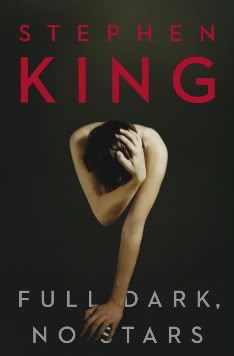
Book Review: "Full Dark, No Stars" by Stephen King (2010)


Warning: some spoilers below


As much as I love, love, LOVE Stephen King, I'll be the first to admit that, even at his very best, he can be kind of a clumsy writer. Much as King himself described the late, great Robert E. Howard (of the original "Conan the Barbarian" stories), King tends to wield his considerable talent as bludgeon rather than a scalpel.

But, while he will never be a perfect writer, he is -- at his best -- a near perfect storyteller.

Full Dark, No Stars is a case in point.

The problem with Big Steve -- can I call you Big Steve? Thanks -- is that, as soon as he turned into a Bestsellasaurus Rex (his phrase), he appeared to believe that he really didn't need an editor anymore. I've always bristled at the oft-stated cliché that Steve could publish his laundry list if he wanted. But, as much as I hate to admit it, it's true. And, as time went on, the books just got longer...and longer...and longer...

Last year's Under the Dome was heralded by many as a return to form. It garnered (ridiculous) comparisons to The Stand. I disagree. It was good, but it wasn't great. The closest Steve has gotten to greatness in recent years was 2002's From a Buick 8, which -- aside from an absolutely godawful final chapter that I have since tried my best to block from my memory -- was taut, tight, original, and very scary. It was also the shortest book he had published in a long, long time.

Even though he has become so known for his massive, phonebook-sized tomes, with the exception of The Stand(1978), It (1986) and maybe Bag of Bones (1998) , most of them grow more exasperating than exhilarating as they ramble on (two of them -- 1987's The Tommyknockers and 1994's Insomnia -- are damn near unreadable).

This is what makes Full Dark, No Stars the first true King classic in probably about 15 years. It's a collection of novellas, much like the masterful Different Seasons (1982) and the very-good-if-not-quite-masterful Four Past Midnight (1990). This is the length where King is at his best. Most of my favorite King stories -- The Body, Rita Hayworth and the Shawshank Redemption, Apt Pupil, Secret Window, Secret Garden -- appeared in one of those two books. My other favorite King story, The Mist, is another novella first published in Kirby McCauley's Dark Forces anthology (1981) and reprinted in King's own Skeleton Crew (1985).

Add to that list at least two of the stories in the new collection. This is King at his leanest, meanest, darkest, Bachman best.

The first, longest, and best story in Full Dark, No Stars is 1922. Told in the first person in the form of a written confession by Nebraska Farmer Wilfred James, 1922 is a black-as-pitch examination of how apparent good fortune can lead to catastrophe. Wilfred's wife, Arletta, comes into an inheritance of 100 acres from her dead father. Arletta wants to sell the land and move to Omaha to open a dress shop. Wilfred wants to add the land to his own 80 acres. An immovable force meets and unstoppable object. Eventually (no spoiler here, this is revealed on the first page), Wilfred convinces their fourteen-year-old son, Hank, to help him murder Arletta and dump her body into an old well.

This being a Stephen King story, things go disastrously awry. The punishment meeted out to Wilfred, Hank, and Hank's innocent girlfriend Shannon is as tragic as it is absolutely horrifying. Supernatural elements aside, it's also all strangely plausible, rooted in the truth of 1920s Midwestern farm life.. King is a master at finding horror in everyday objects and situations, and in 1922 such things as a cracked drain pipe and a lady's hatbox gain almost totemic significance.

And, of course, there are the rats. I've never really had a fear of rats before, but I do now.

Steve follows this with Big Driver, a 70s-style rape-revenge fantasy that thankfully stays away from the inherent exploitation elements (Steve depicts the assault itself in just a couple pages, wisely getting in and getting out as quickly as possible) and instead focuses on the trauma and the aftermath. The lead character, Tess, is a semi-successful mystery novelist assaulted and left for dead on her way home from a lecture. Instead of reporting her attack she instead decides to exact her own justice. Steve makes a lot of the disconnect between Tess's fictional, light-hearted murder mysteries and the true horror of what she has experienced.

The story rings some false notes (there are a couple twists and turns that had me shaking my head) and wraps up altogether too neatly, but King paints a portrait of trauma that is both harrowing and heartbreaking, and you'd have to have a heart of stone not to cheer Tess on when her simmering rage inevitably turns to murder.

Fair Extension, the third and shortest story, is the only one that sort of feels like fluff. Streeter is a miserable man in his early 50s dying of cancer. He meets a stranger by the side of the road who may be the Devil himself. Ole' Scratch offers Streeter a deal: he'll give Streeter a "life extension" if he agrees to fork over 15 percent of his income (it seems Satan has lost interest in souls and is instead looking for Caribbean tax shelters). The catch is that Streeter has to pick someone to receive all his bad luck. Streeter picks his best friend from childhood, Tom Goodhough, a successful businessman with a perfect family whom Streeter has secretly hated for decades.

The story is a breezy and entertaining black comedy, but there's very little substance to it. We get to see Streeter's life improve as Tom's falls apart in Biblical ways. That's about it. What I did like, however, is how Steve essentially turns the old Faustian morality tale on its head. We keep waiting for Streeter to get his comeuppance. It doesn't happen.

The book ends with A Good Marriage, which is Steve's meditation on Dennis Rader, the BTK Killer, and how his wife claimed to know nothing of his murderous ways. Probably the less said about this one the better. Again, Steve very astutely stays away from most of the seamy details of the killings and instead focuses on the sheer horror of what it would be like to find out that the sweet, attentive husband you have shared a bed with for more than a quarter-century might actually be a psychopath. The story unfolds in some nice, unexpected ways, and leads to a conclusion that is -- while predictable -- ultimately satisfying. In many ways, it's the quietest of the four stories. It's also probably the most chilling.

I have no illusions that Full Dark, No Stars is going to be the start of a Stephen King renaissance. I'm sure his next book will likely be another bloated, overplotted brick. I'll read it anyway, and I'm sure I'll (mostly) like it. But until then, I'm thankful to have a little taste of the old, transcendent King that I have yearned for for so long.

Monday, November 15, 2010

A few thoughts on the response to "SEND"

SEND (2010) from Trifecta+ Entertainment on Vimeo.


I sort of feel like trying to write a really good story is a bit like conducting surgery while blindfolded. You hack away at the thing, hoping you don't hit an artery and kill it. You try to find the infected appendix or whatever it is you're looking for by touch alone and take it out.

And sometimes your hand slips and you stick your scalpel into a bundle of raw nerves.

That seems to be what's happened with "SEND."

I went to see a play back in August -- "Trust," by Stephen Dietz -- and I was floored by this one scene. One character confronts another about his infidelity. Glasses are thrown. Accusations are hurled. And my jaw was on the floor.

The actress in that scene was Amelia Ampuero, and I immediately had the thought that I wanted to do a movie with her where I would just put the camera on her face and let her do her thing. It seemed sort of crazy, like something you think about and right away realize won't work at all.

But then -- and this is just the way my brain works, folks -- I suddenly had this image of her covered in blood and talking about eating a rat. To steal my favorite metaphor from Stephen King, my Muse took a big old crap on the top of my head and the idea was there, whole and pretty much fully formed.

That's it. I initially thought this would just be a little web video, something I could post quickly while we were finishing up some of our larger projects. I figured it would be, at most, ten minutes long. I hammered out a draft that came out to about thirteen pages, sent it to a few friends for feedback, and contacted Amelia to see if she was interested.

Once Amelia agreed to do it, I incorporated some of the notes I had gotten from friends and started fleshing out the script. It began to bloat over the coarse of a few drafts, ending up at about twenty pages. A little long for a web video, but whatever. It would still be super easy to shoot, which was what I was looking for at that moment. Some people would stick with it, I figured, and some wouldn't.

As far as the content itself, as I saw the story taking shape I realized this had the potential to be a really striking and unsettling little film if we did it right. I liked that. I thought the movie would fuck with people. That's good. I like to fuck with people.

The shoot went well. Amelia was incredible, as I knew she would be. Mary's makeup was stunning. I started thinking that maybe this was a bit more of a "real" film than I had initially figured it would be.

I sort of knew I had a tiger by the tail when I started editing it last Monday. Amelia's performance was absolutely riveting. I found myself just sitting and watching it rather than working on it.

But I still had no idea.

After I posted it on Friday, I watched as the number of views climbed up to 100...then 300...then suddenly 1,500...3,600...finally over 6,000. Over 80 people reposted it on Facebook. An untold number sent the link to their friends via email. It wasn't exactly viral, but it was on its way.

Then the emails started rolling in. Amongst all the "way to go"s and "that was awesome"s that you expect to get from your friends, I started getting email after email from people I didn't know. Most of them seemed to be from women, many of them mothers. They all told me the movie made them cry. One woman told me that, immediately after watching it, she went and hugged her kids and then called her husband while he was at work to tell him she loved him. Yet another told me the movie was making her "rethink the way I'm living my life."

To which my response was "...uh...what?"

And then I got this email this morning:

"hi. you dont know me. a friend sent me a link to your movie Send and I just felt like i had to write to you to express my gratitude. I felt you made this movie about me. a year ago i split up with my husband. It has been a nasty divorce and i have at times even contemplated suicide, only not doing it because of my kids. but then I saw your movie and it made me realize what is important, and i cannot thank you enough. thank you thank you thank you"

(I wrote back and asked the sender -- who will remain anonymous -- if I could reprint that here. She said yes.)

I just don't know what to say to that.

I don't want to overstate this. I know we didn't cure cancer or anything. We made a movie. I guess all I can say is that I'm absolutely floored, humbled, and completely overwhelmed by the response. As a writer and filmmaker I've never experienced anything remotely like it before.

One thing I absolutely must say, though, is that I refuse to take credit. Sure, I think I wrote a pretty good script. But I had help from friends, who were not shy about telling me what worked and what didn't.

Really, this movie only exists because of Amelia. It was watching her on stage that inspired me to write it, and it was her performance in the film that, I believe, has led to the response that it has had.

And, of course, there's my beloved Trifecta team. There's Mary's makeup. You truly have to see it to believe it. There were Bust's costumes and guns, which is what gives that last scene the boxer's punch that it has. And -- even though I sort of shot this one myself -- there was Corey's invaluable advice and help with the lighting.

Beyond that, I don't really have anything else to say. I really, honestly had no idea. Sometimes you just stick your blade into a bundle of nerves, that's all.

Sunday, September 26, 2010

Two new albums by Grinderman and Dead Confederate


Grinderman - "Grinderman II"


When Nick Cave stepped away from his piano and picked up a guitar in 2005 and started writing the messy, blues-punk songs that eventually coalesced into his 2007 side project Grinderman, it was clear that the dour Australian was looking to break from the bleak confines of The Bad Seeds and have himself a little fun. Grinderman was a welcome departure, even for die hard Seeds fans like myself, completely tossing aside the Gothic melancholia of his regular band (at least in its more recent outings) and harkening back to his snarling days with seminal Aussie punk band The Birthday Party in the early 1980s. With the album's first single, the viciously hilarious "No Pussy Blues," Cave showed the world that he could still cut loose and have a laugh.

Now he's back with Grinderman II. Where Grinderman was a fun but ultimately pretty depthless diversion, the new album is probably Cave's best and most vital new music since the Bad Seeds Nocturama in 2003. At the very least, it's a marked improvement over both the first Grinderman album and the Bad Seeds' somewhat lackluster Dig, Lazarus, Dig!!! (2008).

Announcing itself with a roar from the very first track, the absurdly titled "Mickey Mouse and the Goodbye Man," Cave and his crew have managed to craft an album that has all the gnarled, messy punk-rock swirl of their first effort along with the brooding Apocalyptic menace of The Bad Seeds at their best. Whereas Dig had a few good songs sprinkled amongst a lot of filler and Grinderman sort of ran out of steam about three quarters of the way through, Grinderman II stays taut and focused until the very last note. This is music from the id. There's nary a misstep here.

And if you haven't seen it yet, you must check out the completely unhinged video for the album's first single, "Heathen Child" (NSFW). WTF?


Grinderman - "Heathen Child"
Uploaded by naivepromo. - Watch more music videos, in HD!


Dead Confederate - "Sugar"


Dead Confederate are a really solid band from Athens, Georgia, who have never quite lived up to the promise of their first self-titled E.P. in 2008. That collection of five songs -- from the gloomy swagger of their first single "The Rat" to the bludgeoning stomp of the E.P.'s closing track "Shadow the Walls -- just came out of nowhere and crushed me. I don't think it left my earphones for about five months.

Their first full length album, Wrecking Ball came out at the end of that year, and had some real highs and lows. They re-recorded "The Rat" and somehow managed to sap the song of its energy, and other tracks like "Yer Circus" and "Heavy Petting" felt like half-baked filler. But they nailed it with "It Was A Rose," "Goner," and "Start Me Laughing." They were sort of dismissed by critics as Southern neo-grunge, but really at their best they were loud alt-country with a bite, displaying aural flourishes drawn from influences as disparate as Skynyrd and Floyd, Nirvana and Joy Division.

Their just-released second album, Sugar, is an odd departure. Noticeably absent are the alt-country touches that defined their sound early on. This record is much more rooted in late 80s/early 90s post-punk -- undoubtably influenced in no small part by their association with J. Mascis of Dinosaur Jr., with whom they toured last year and who makes a guest appearance on the album's first single, "Giving it All Away."

It took me about three listens to decide that this is actually a much stronger album than Wrecking Ball, which for all its assets can be a singularly frustrating experience to listen to all the way through. Where Wrecking Ball featured some real standout tracks but didn't cohere as an album, Sugar doesn't feature any one song that will jump out at you but somehow comes together magnificently as an entire work.

There's something weirdly fractured and unpleasant about this album ... and I mean that as a compliment. The songs drone and crash without any real obvious sense of purpose, but then somehow it all just comes together in the end. There's very little of what you could call a hook anywhere to be found, and yet the album as a whole has a strange momentum and builds a dark, almost schizophrenic mood that, by the end, seeps into your pores. It's what Sonic Youth and Fugazi do at their best.

Unfortunately, the one glaring weak spot on the album is the single. The song just kind of jangles along and then ends without any real impact. The only thing moderately memorable is Mascis's buzz-saw guitar solo. If it hadn't been for that, I would have said they should have just that one on the cutting room floor.

Luckily they've released another video for a much better song, "Run From the Gun." Check it out.

Wednesday, September 15, 2010

Is it possible to fall in love with a blogger I've never met before?

Yes.


Hyperbole and a Half, by Allie Bosh


I might be a little late to this party, but this blog is funniest goddamn thing I've run across in a very, very long time. Allie is a multi-talented wunderkind, able to write hilariously disturbing and oddly touching stories and wield MS Paint like it's a weapon.

She's like Don Hertzfeldt, but with more heart.

And she's hot.

I don't even remember how I stumbled across it, but I'm now thoroughly addicted. I want to blame this on the stomach flu that's kept me in bed most of the day, but I've literally gotten nothing done today beyond reading and rereading her posts, perusing the photos on her Facebook page, and secretly plotting how I'm going to move up to Montana and somehow break up her and her boyfriend (what's his name? Duncan? Whatever).

Yes, I am now officially an Internet stalker.

So in the interest of regaining a small piece of my dignity, I'm going to try to pretend that this post isn't merely a desperate ploy for Allie's attention and mention a few of the other blogs and websites that get me through my day.

Fuck You, Penguin


www.fupenguin.com


Sadly, I think this one might be dead. There haven't been any posts since November of last year.

But who doesn't want to yell at pandas and tell them they're stupid? I know I do.

If you haven't seen it, it's worth going through the archives.

Lamebook


www.lamebook.com


This one is alternatingly hilarious, disturbing, and deeply depressing. Sometimes while reading it I'll hurt myself laughing and sometimes I'll tremble in fear and weep for the future of humanity. Usually when I'm done I feel really horrible about myself and the rest of my species.

But it's like crack. I just can't seem to quit.

And speaking of crack...

Cracked


www.cracked.com


Probably my most visited site on the Internet (second to Wikipedia, of course). Funny, weird, and surprisingly informative. I enjoy the videos (particularly the ones by Michael Swain) and the web comics, but it's the lists that keep me coming back over and over again.

Some of my favorites:

5 Popular Zombie Survival Tactics (That Will Get You Killed)
The 7 Most Horrifying Museums on Earth
The 17 Most Unintentionally Hilarious Propaganda Posters

Most of these websites can't really be defended as anything other than a waste of time, but I've found that Cracked is actually great for research and has inspired more than a few story ideas. So suck it.

The Daily Beast


www.thedailybeast.com


Okay, so maybe now I'm feeling a little defensive about my Internet habits. But I do go to this one regularly for my politics and news fix. It's not as up-to-the-minute as The Huffington Post or Politico, but that only gives it the added bonus of having articles that are actually well-written and contextualized.

Playground of Doom


playgroundofdoom.blogspot.com


Hey, I know this guy!

Doesn't matter. I still genuinely get excited every time Dusty posts a new blog. It's like getting a little snark-filled Christmas present in my Facebook inbox.

It doesn't hurt that Dusty and I have similar sensibilities (Inception aside). But I love how he approaches reviews of things as diverse as Machete, Five Easy Pieces, and The Hand with the same snap wit and lack of pretension (a lesson I should probably take for myself), and that he's not afraid to turn the snark on himself.

And -- sorry Dusty -- he's also the ultimate contrarian. He literally does not give a shit what you think. Awesome.

For some other cool blogs written by people I know, check out Cinewise by Gurur Sarbanoglu; A Modern Girl's Guide to Surviving the Apocalypse by Mandy Connor, Dana Horgan, and Bridget Tyler; and The New Jonny Transit Blog by Jon Curtis.

Wednesday, September 1, 2010

Cee-Lo's "F*ck You" and the joy of a good novelty song


Cee Lo Green "Fuck You"
Uploaded by Push36. - Explore more music videos.

I'm not gonna lie. Cee-Lo's "Fuck You" might be my favorite song ever.

It seems to be a lot of people's favorite song ever actually. Last I heard it had hit something like two million views on YouTube within a week of it's release.

This, to me, is the very definition of the perfect novelty song.

1) It's catchy. Oh, is it ever catchy.

2) It's funny.

3) It's kind of naughty in a "I can't believe he did that" sort of way.

4) It's actually a pretty good song.

So in honor of this monumentally awesome track, here's my list of my top 5 novelty songs of all time.

And no, there won't be any Weird Al Yankovic on this list.

Ben Folds - "Bitches Ain't Shit"


The effete white dude doing the acoustic cover of the hardcore rap song has been a novelty-song cliché since about the mid 1990s, when it seemed like everyone suddenly discovered irony.

I was first introduced to this phenomena as a college radio DJ with Dynamite Hack's cover of Eazy-E's "Boyz N The Hood", which is pretty funny, but Ben Folds actually comes close to transcending the whole idea of the novelty song with this track. The mournful piano actually adds a certain melancholy weight to the rank misogyny in the lyrics. It's funny and ironic, sure, but kind of creepy too.

Anthrax and Public Enemy - "Bring The Noise"


Hard as it is to believe now, once upon a time the idea of a heavy metal band and a rap group getting together to record a song was nearly inconceivable, sort of like Jews for Jesus or Mormons for Jack Daniels and Strippers.

Now, in the post Limp Bizkit wreckage of our sad little lives, whatever novelty was to be had in the concept is long gone. But I still love this song. I don't care what you say.

See also Anthrax's first foray into rap with "I'm the Man".

William Shatner - "Lucy in the Sky With Diamonds"


The amazing thing was that, at the time, this wasn't meant to be funny. People thought that this would really turn Shatner into some sort of art poet pop star or something.

Luckily, Shatner figured it out later and has crafted a nice little second career making fun of himself on Priceline commercials and Conan O'Brien.

And speaking of Star Trek...

Leonard Nimoy - "The Ballad of Bilbo Baggins"


The less said about this the better.

Moving on.

Vincent Laguardia Gambini - "Take Your Love and Shove It"


This is my personal favorite on this list. Joe Pesci playing his character from My Cousin Vinnie embarking on a second career as a potty-mouthed lounge singer. What more do you need?

Tuesday, August 31, 2010

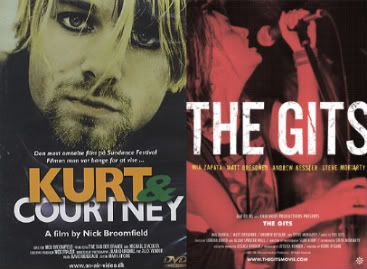
Death and Rock in Seattle: "The Gits" (2005) and "Kurt & Courtney" (1998)


Seattle was the center of the music universe in the early 1990s. The scene led to maybe the most profound paradigm shift in mainstream rock and roll since the British invasion of the 1960s. Having the words "Seattle band" come before your name could almost guarantee you a record deal. Bands from the scene (most famously Soundgarden, Pearl Jam and Nirvana, but also groups like TAD, Screaming Trees, and the Melvins) repurposed the fury of punk and combined it with the groove of heavy metal to create something new and seemingly vital and, for a short time at least, filling a much-needed void. The musicians were snarly girls with dreadlocks and nose rings and angry guys with stringy hair and goatees. They wore flannel, Converses and torn T-shirts, and they uniformly rejected the lip-gloss-and-leather-pants excess of 1980s cock rock. Bands like Poison and Warrant and Nelson and Winger spasmodically went the way of the Dodo. Earnestness and "authenticity" were fashionable again.

And then it all fell apart.

Two violent events, occurring within about a year of each other, brought about the near immediate death of the scene. The first was the brutal rape and murder of Mia Zapata, lead singer of The Gits, in 1993. The second was the suicide by shotgun of Kurt Cobain, the closest Generation X had to a genuine John Lennon figure.

A pair of critically acclaimed documentaries chronicle these two events. Nick Broomfield's Kurt & Courtney came out in 1998, when the wounds were still pretty raw. Kerri O'Kane's The Gits appeared in 2005, long after the dust had settled.

The Gits is a pretty standard rockumentary tribute to Zapata, combining archival concert footage, photos, and talking heads spouting platitudes about how influential the band was and how amazing a person and singer she was. It's too bad the movie isn't more adventurous, because the subject matter is fascinating. The Gits were one of Seattle's best undiscovered gems, right on the verge of cracking the mainstream, when Zapata was killed. They were a pretty straight-forward hardcore punk band and weren't really part of the adjacent (and largely rival) grunge scene. Zapata's skill as a singer was truly astonishing. She was sort of a snarlier and bluesier Patti Smith, and her powerhouse talent and her generous support of the bands that came in her wake helped give birth to the Riot Grrrl movement (which included celebrated girl punk bands like L7, Bikini Kill, and the direct Gits-disciples 7 Year Bitch).

The first half of the documentary follows the band's rise, from their early days at Antioch College in Ohio to their dominance of Seattle's punk scene. Her former band members expound on Zapata's brilliance, and the musicians from the other scene bands like 7 Year Bitch and DC Beggars talk at length about her influence. It's all fairly banal stuff, with a few amusing anecdotes thrown in (the most charming moment is a clever montage of her various friends lovingly impersonating her gravelly voice). But it's the concert footage that shows the truth of her abilities. I'm sorry, but the woman could sing.

The story takes it's unfortunate turn at Zapata's murder. Zapata was walking home from a bar after spending the night hanging out with members of 7 Year Bitch when she was accosted, beaten, raped, and strangled. The police searched for nearly a decade for the killer, operating on the assumption that it had to have been somebody she knew. Men from all over the punk scene were interrogated, and the women walked around in fear, not knowing if the killer moved amongst them. The camaraderie of the scene was shattered, and -- as one interviewee said -- almost all the bands broke up within a year of her death. The magic, as they say, was gone.

I wanted O'Kane to really dig into the psychology of that dark time, but -- as is the case in the first half of the film -- she's content to just skip over the surface. The only real emotion we see is from Zapata's father (who seems like the best and most loving dad a hardcore punk girl from Kentucky could ask for) and from 7 Year Bitch singer Selene Vigil, who -- years after the tragedy -- seems still shaken by the death of her friend and mentor. But O'Kane just keeps pumping out the platitudes about how awesome Zapata was, and after awhile you're left with the sense that she must have been the Mother Teresa of Seattle's punk scene. No one has a single unkind or complicating thing to say ab out her. I'm sure she was as lovely a person as everyone says she was, but O'Kane never really finds a way to humanize her. She leaves her as a martyr and an idol, not a person.

There's a happy ending, of sorts, when the police finally make an arrest using DNA evidence 10 years after her murder, but the impact of that final turn is muted by the fact that O'Kane never really brings home the pain of her loss.

Still, with all its flaws, The Gits is worth a watch if you have even a passing interest in the subject. As I said, the concert footage alone is worth it.

Nick Broomfield's Kurt & Courtney is the much more stylish film. Broomfield has a much stronger sense of cinematic language, and he largely eschews the conventions of the talking-head documentary. He moves the camera, for one thing, and rather than just showing us the interviews he gives us all the awkwardness of the first meetings and introductions (my favorite is Kurt Cobain's old high school teacher, who yells at the filmmakers as if they're tardy students before finally settling down and agreeing to the interview). This gives the film a lived in, organic feel and adds to the sense of verisimilitude ... which is important considering that Broomfield's film is less a tribute and more a piece of conspiracy-theory agitprop.

"I didn't have an angle on the story," Broomfield says in what has to be one of the most stupendously disingenuous statements in the history of documentary filmmaking. "I was just trying to find my way through it." Yeah. Right. I call bullshit on that one.

Broomfield is an excellent craftsman and he knows how to structure a narrative. In Kurt * Courtney he tells three stories simultaneously: that of Kurt Cobain's rise and fall, that of the Courtney Love's alleged involvement in his death, and that of himself -- the poor camera-wielding David versus the Goliath that is Courtney Love and the Hollywood media machine -- battling to get his film made.

Broomfield's main thesis (although he denies it) is that Courtney Love had Kurt Cobain killed to protect her financial and professional interests. To prove his point, he travels the country (okay, the West Coast) and interviews a bunch of crackpots and junkies, each of whom has his or her own story to tell. The most fascinating are Cobain's clearly drugged-out best friend (who may have been in on the plot, Broomfield slyly suggests), Courtney Love's estranged father (who is convinced she had him killed and is apparently making as much money as he can off the accusations), and -- of course -- Eldon Hoke, otherwise known as "El Duce." Hoke was the lead singer of the notorious "rape rock" band The Mentors (they made GWAR look like a Disney attraction), and he claimed that Love offered him $50,000 to kill Cobain. He lived a squalid, hillbilly existence out in Riverside, CA, and at the time of his interview he looked to be about 39 going on 60. It's not hard to believe this guy could have killed someone, even if his story stinks like a rotting fish in the noon sun. At one point Broomfield asks Hoke how Love had suggested he commit the deed. "Blow his fucking head off!" Hoke shouts, clearly giddy at the idea. "That's the way it's done!"

Interestingly, Hoke was struck and killed by a train just a few days after his interview, which of course threw a whole mess of gasoline on the already raging conspiracy-theory fire.

To be fair to Broomfield, he doesn't really try to convince us that these people are anything but crackpots and junkies, and he gets a lot of narrative mileage out of the growing uncertainty surrounding his quest. "I no longer knew whether anything anyone was telling me was true," he says at one point, and you can just about hear the thunderclap going off on the soundtrack. The only person who seems unquestionably honest is Cobain's beloved aunt Mary, an ever-smiling and hyper religious woman who seems so homespun and saintly as to be almost creepy. I wondered if maybe she had wandered in from a forgotten episode of Twin Peaks.

Broomfield is cut from the same cinematic cloth as fellow agitprop documentarians Michael Moore and Morgan Spurlock, and he knows the benefit of having a good villain. When Broomfield finally confronts Love at a swanky ACLU dinner in Los Angeles, it's impossible not to think of Moore raging at GM chairman Roger Smith at the end of Roger & Me. Like most of Moore's movies, this film is shamelessly manipulative, embarrassingly narcissistic ... and pretty damn effective. By never outright stating that he thinks Love killed Cobain and by allowing himself to (on camera, at least) question the veracity of the evidence like a true journalist, he manages to create a pretty convincing argument that, at the very least, the question itself isn't completely insane. He uncovers enough genuinely weird stuff to make one wonder.

And, whether or not she actually had Cobain killed, Love is unquestionably the villain of this movie. Broomfield's idea seems to be that, at the very least, she probably drove him to suicide (another former lover of hers pretty much says as much). No one is going to walk away from this movie mistaking her for a nice person.

Whether or not you believe the conspiracy theories, Broomfield's documentary is pretty interesting and, in its way, genuinely thought provoking. But, please, take it with a grain of salt.

Wednesday, August 25, 2010

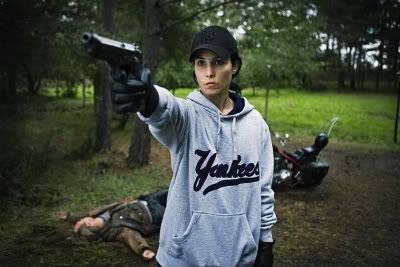
The Girl Who Played With Fire (2009)


There's been a lot of hype about the upcoming American adaptation of Swedish author Stieg Larsson's international bestseller The Girl With the Dragon Tattoo. The film is based on a bonafide literary phenomenon, set in an exotic location (Sweden), and sports an A-list director (David Fincher), a solid movie star (Daniel Craig), and -- now -- a mostly unknown actress (Rooney Mara) thrust into a virtuoso role that has become a feminist icon worldwide.

So -- as all the book's fans go apeshit, both pro and con, about what Fincher may or may not do with this material -- it's easy to forget that these movies have already been made. And been made pretty damn well, at that. The Swedish movie version of The Girl With the Dragon Tattoo is already a major smash worldwide (with over $100 million in box office) and has received a ton of critical acclaim.

The sequel, The Girl Who Played with Fire has just been released in the U.S. and the final, The Girl Who Kicked the Hornets Nest will come out in the fall.

I liked The Girl With the Dragon Tattoo well enough, but nowhere near as much as I liked the book. The filmmakers did about as good a job as they could have condensing the massive story into a single film. It was gorgeously shot, well acted, and solidly directed. But it kept me at arm's length in a way that the novel didn't. Somehow I didn't quite connect to the characters the way I wanted to. The whole thing fell just a little bit flat to me.

The Girl Who Played With Fire is an even more ungainly book to try to turn into a film. It has a lot more action, sure, but it's all wrapped up in an absurdly convoluted plot with what seems to be an entire platoon of brand new characters to wrap your head around. Where Tattoo was at heart sort of a standard locked-room mystery, Fire spans all of Sweden and features about eight different storylines all bashing into each other like a massive game of bumper cars.

Don't get me wrong; I absolutely love the book for all its flaws. But I wasn't entirely clear how exactly it could make the jump to the big screen. I was pretty nervous about how it would work.

So it's with a sigh of relief that I can report that not only is Fire a much stronger film than its predecessor, but it's actually an improvement in many ways over the original novel.

The key to the success of both the novels and the films are the two leads: Mikael Blomkvist (Michael Nyqvist), a crusading journalist and ladies' man (and obviously an idealized version of Larsson himself), and Lisbeth Salander (Noomi Rapace), a brooding anarcho-punk computer hacker with the iron will of a Roman Centurian and the social skills of a bar napkin. Tattoo was about introducting these two opposites so that they could solve a twisted decades-old murder mystery and, eventually, fall into bed together. They make one of of the most compelling crime-fighting duos since Holmes and Watson, Fraser and Diefenbaker, and Simon and Simon.

Where Tattoo was about bringing Blomkvist and Salander together, Fire is about keeping them apart. Salander's on the run after falsely being accused of murder, and Blomkvist must desperately try to clear her name. Meanwhile, there's a bunch of stuff about sex trafficking, Russian double agents, a lecherous lawyer with a secret, a Swedish biker gang, cops being led down the wrong path, and -- at the center of everything -- a murderous blond giant who can't feel pain and who beats people to death with his bare hands.

Rapace is far prettier and much more voluptuous than Salander is described in the books, and in Tattoo that threw me a bit. Lisbeth is described at being so slight that she's often mistaken for a boy. Seeing the statuesque Rapace fill the role felt a bit like watching Angelina Jolie try to play Hermione or something. That took some getting used to.

Nyqvist looks more the role, but the first time around he just sort of disappeared for me. His Blomkvist in the first movie felt a bit like a sketch rather than a fully developed character, and the heat and eventual deep bond that develops between him and Salander just never quite rang true for me the way it did in the book. And without that bond, there's not much else to hang your hat on.

Fire features a different screenwriter and director (Jonas Frykberg and Daniel Alfredson), and I think they deserve credit for digging deeper and finding that heat that lives at the heart of these stories, which is even more impressive considering that in this film Blomkvist and Salander share a total of about two minutes of screen time together. Nyqvist finally seems to settle into the role, finding the complexities that exist in the books and pushing past Blomkvist's too-cool exterior to the troubled firebrand underneath. He captures both Blomkvist's unyielding sense of integrity as well as his at times alarming and even dangerous well of arrogance.

Rapace is the real revelation, however. She did a fine job in Tattoo, but I had a hard time getting past her beauty, and her makeup and wardrobe felt like a glamour photographer's interpretation of what an anarcho-punk computer hacker should look like. She's just as beautiful in Fire, but Alfredson wisely dresses her down for much of the movie, giving her a stringy mop of hair rather than the hipster coif from the first film, keeping the Goth makeup to a minimum, and generally clothing her in baggy T-shirts and sweatpants. This gives Rapace room to scratch past the surface of the character, cracking through Salander's snarling exterior and showing the aching vulnerability and the deep loneliness that lurks beneath. For the first time, I felt like I was actually watching the Lisbeth I had fallen in love with in the books.

And I have to say I was very pleased with the casting of German actor Mikael Spreitz as Niederman, the aforementioned murderous blond giant who it turns out is much more deeply connected to Salander than anyone could imagine (dah dah DUM!). Nierderman is an absolutely terrifying character in the book, but he could have easily become a cartoon in the film. Spreitz manages to capture not only Niederman's brute physicality, but his viciousness, his intelligence, and his oddly childlike vacantness as well, and all with a bare minimum of dialogue to work with. He turns in a truly towering (pun definitely intended) performance.

But about that lumbering plot?

Larsson wasn't really a master plotter. In Fire in particular, he relied way too heavily on coincidence and narrative convenience. Frykberg and Alfredson do a really stunning job of streamlining his unwieldy text and actually make some very noticeable improvements to the material. They trim the fat and restructure the story subtly so that it feels almost plausible. They establish the many side characters through action and behavior rather than exposition and backstory (until the end, when the backstory becomes crucial to the plot). It's a still a fairly ludicrous story, but at least this time you spend less time thinking about how ludicrous the story is.

Some fans are inevitably going to howl that the film merely skates over the surface of the material and offers a sort of Cliffs Notes version of what Larsson was trying to get at. The film is certainly far less concerned with the political and social commentary that compelled Larsson (an avowed leftist and anti-misogynist) to write the books in the first place. This is to the film's advantage, however, because Larsson's biggest weakness (aside from his at times lazy plotting) was his tendency to launch into eye-roll-inducing speeches to make his points. All that substance remains in the film, but Frykberg and Alfredson simply choose not to bash us over the head with it.

It's hard to know how, if you have only a passing knowledge of the books or the first film, you might respond to this movie. My dad saw both movies without reading the books, and he seemed to enjoy them quite a bit. But I have a feeling many people will be left somewhat cold without the foundation of the books to guide you through all the different characters and the serpentine plot. But I'd say give it a shot, and then go back and read the books for all the cool stuff you missed.