Tuesday, June 16, 2015

Streaming Review — One False Move (1992)

"One False Move" is one of those odd little movies I've been hearing about for years but haven't ever  taken the time to sit down and watch.

I remember the moderate buzz surrounding it way back when. It came out in the year or so after "Reservoir Dogs," so the whole neo-noir indie thing of that time was just getting started. Directed by an actor and relative nobody named Carl Franklin (a nobody in the sense that he's worked mostly under the radar; in truth, he's done some pretty solid work both behind and in front of the camera) and written by and co-starring a complete nobody named Billy Bob Thornton, "One False Move" was basically a B-movie intended for the direct-to-video bin at your local video store. It wasn't until critics like Roger Ebert and Gene Siskel took up the cause that it finally got a small theatrical release (Siskel named it his movie of the year)

In the years since, it's grown into a minor cult artifact, largely because of the stratospheric rise not long after of its writer and star (Thornton would go on to make his breakout "Sling Blade" just a few years later).

It's one of those movies I think about watching every so often and then quickly forget. But it came up while prepping a new script I'm due to start soon, I decided to finally sit down and watch it.

Final verdict: pretty good. It's no masterpiece, but it's a more-than-solid slice of rural noir, and definitely worth a look.

The film mostly centers on a dual, criss-crossing narrative that follows a gang of murderous robbers and drug pushers comprised of the volatile and violent Ray Malcolm (Thornton), his slightly more sensible lover Fantasia (Cynda Williams, who was Thornton's real-life girlfriend at the time), and the coolly psychopathic Pluto (Michael Beach, who should be recognizable to modern audiences as T.O. Cross on "Sons of Anarchy"), and two L.A. cops (Jim Metzler and Earl Billings) who team up with a small-town sheriff (Bill Paxton) in hopes of intercepting the gang upon their arrival in Ray and Fantasia's home town of Star City, Arkansas.

In many ways this is all pretty standard fair. What makes the movie hum are the performances and Thornton's solid, if not wholly original, screenplay. Everyone is good here (Beach, in particular, plays Pluto with just the right mixture of brute menace and cool intelligence), but Paxton steals the show as Dale "Hurricane" Dixon, a small-town cop with big-time dreams. We know from the start that his inexperience, exuberance, and overall lack of intellectual rigor are likely to get him (and maybe a lot of other people) killed. Imagine if George W. Bush was a small-town sheriff about to go up against a gang of cold-blooded murderers.

But lest you think this is simply another Hollywood movie condescending to and fetishizing the rural south, remember that Thornton himself is not so different from Hurricane Dixon. He grew up in this world, and he knows it as more than a bag of clichés. When we meet Dale and first experience Star City, we're taking it all in through the eyes of the jaded and arrogant big-city cops, and Thornton's sly trick is to make the condescension theirs, not the movie's. He fakes us out by putting us into their subjectivity, then pulls the rug out from under us by dumping us right into Dale's. Dale is suddenly more complex, heartfelt, flawed — but inherently noble — than we previously imagined.

Thornton is also pretty great as Ray. It's the type of role we've become accustomed to seeing him in, but it's handy to remind ourselves that, at the time, nobody knew who the fuck he was. Yet he manages to dominate the screen like a seasoned veteran.

The ultimate confrontation between all these forces is powerfully presented, but overall pretty predictable. Nothing here really gives us anything we haven't seen before or since. "One False Move" may be one of the first of those 90s rural noirs, but it's far from the best (that honor goes to either John Dahl's 1993 film "Red Rock West" or Sam Raimi's 1998 film "A Simple Plan" — the latter of which not-so-coincidentally stars both Thornton and Paxton).

Still, this is a movie that's a lot better than in it should be, and that's due to the talent involved. Franklin, for his part, directs the film ably and with just enough style to elevate this beyond other direct-to-video fare from that era. He's not showy, but he shows a solid command over the form.

This is a good movie. If you haven't seen it, you should give it a shot.

Book Review — "Finders Keepers" by Stephen King

Mild spoilers below

Last year, when I wrote about Stephen King's "Revival," I expressed my cautiously optimistic hope that King was maybe finally pulling out of what felt to me like a decade-plus slump. The quality of his work has been trending sharply upward since 2010's "Full Dark No Stars," and I voiced the opinion that "Revival" was as close to classic King as anything he had produced in a long, long time. 

I'm going to be a douchebag and quote myself real quick:

"I'm not going to make any grand pronouncements about a 'comeback or (ahem) a revival here. We'll have to see if King can sustain this newfound focus with whatever he comes up with next. But, in the meantime, I'm just so grateful to have once again had the exhilarating experience with a new King book that I used to expect as a matter of course."

I've read "Revival" again in the months since this review, and for me it's skating ever closer to earning that classic label. I'm still not quite ready to go there, though.

But I have no such reservations with his latest book, "Finders Keepers." The exhilaration I felt when I read "Revival" is there, but positively squared this time. This is King's best novel — by a wide, wide margin — since his early/middle period ended with 1987's "Misery."

He's had a couple books that have come sort of close in the years since. 1996's "Desperation" comes to mind, as does his fourth Dark Tower novel, 1997's "Wizard and Glass." I personally have a deep fondness for 2003's "From a Buick 8," even if nobody else really does. But nothing (except for "Revival," "Full Dark..." and maybe "11/22/63") has felt like a truly towering achievement since "Misery."

Until now.

"Finders Keepers" is second in a trilogy of crime novels, directly influenced by writers like John D. McDonald (an oft-referenced King favorite). "Mr. Mercedes" was the first in the series but, like with "Star Wars" and "The Godfather: Part 2," it's really the second installment that's the defining masterpiece.

"Mr. Mercedes" was good, but it had its problems. The best things about it are the lead character, retired police detective Bill Hodges, and a truly frightening villain, Brady Hartsfield. The spine of the story is solid, but King wanders outside of its confines and stumbles into areas that challenge our suspension of disbelief. The biggest problems come when King has the elderly and corpulent Hodges enter with startling ease into a passionate love affair with a beautiful, much younger woman ("Revival" kind of has the same Woody Allen-esque old-man wish-fulfillment problem, but you sort of buy it more there since the main character, Jamie Morton, is a rode-hard bad-boy rocker and not a fat ex-cop who starts the book mostly sitting around eating Cheetohs and watching game shows).  These issues only compound when Hodges joins forces with two other would-be detectives — Holly, a middle-aged woman with Aspergers, and Jerome, Hodges's genius teenage neighbor — to stop Brady in his murderous tracks. Jerome and Holly are, like Hodges, pretty great characters on their own, but you just don't quite believe the meet-cute way they all come together.

The third major problem with "Mr. Mercedes" is its overall lackluster conclusion. King had dipped his toes into the hard-boiled world before (most masterfully with his 1985 short story "Dolan's Cadillac," which you can find anthologized in his 1993 short-story collection "Nightmares and Dreamscapes"), but never at novel-length. He's working undeveloped muscles with "Mr. Mercedes," and you can sort of feel him straining toward the end. None of these problems are fatal, but — Edgar award notwithstanding — they knock the book down a peg from "great" to merely "pretty good."

You feel none of that strain in "Finders Keepers" (well, maybe a little when Jerome conveniently shows up again to help out about halfway through). This story takes place four years later, and Hodges and Holly are a team now. Even if their original coming together strained credibility, here King has the advantage of picking up with them after their friendly if not always comfortable rapport has been firmly established.

But fundamentally "Finders Keepers" isn't even really about them. Hodges and Holly don't really join the main action until about halfway through, and they spend most of the rest of the book playing catch-up. The real main characters are a kid named Pete Saubers and a hardened old parolee named Morris Bellamy.

Bellamy is King's most compelling human monster since Annie Wilkes in "Misery." And that might be because, like Annie, Bellamy is an obsessed fan who turns against a famous author. I'm sure that's a subject that hits King right in all the feels.

The author in question is a reclusive genius named John Rothstein. After publishing a trilogy of novels about the life of a wayward youth named Jimmy Gold, Rothstein packs it in and retires to a New Hampshire farmhouse, never to be heard from again. But rumors abound; word on the street is that he never stopped writing.

Rothstein is an obvious riff on J.D. Salinger, but there's also some John Updike and Philip Roth in there. His "Runner" trilogy (comprised of "The Runner," "The Runner Sees Action" and "The Runner Slows Down") seems like a nod to Updike's "Rabbit" novels. And while Rothstein's Jimmy Gold character has a lot of Holden Caulfield in him — he's even got his own catch phrase, "shit don't mean shit" — he's also a clear analogue to Roth's Nathan Zuckerman alter-ego.

"Finders Keepers" opens with an 80-year-old Rothstein being rudely awakened by a trio of home invaders. The year is 1978, and Rothstein hasn't published anything in nearly two decades. Two of the masked men are clearly after Rothstein's money, but the third — Bellamy — wants something else. Bellamy is the criminal-minded estranged son of a respected English professor, and he sees himself as something of a literary sophisticate. In particular, he's imprinted himself deeply onto Jimmy Gold, in the way Mark David Chapman imprinted onto Caulfield and — indeed — Annie Wilkes imprinted onto Misery Chastain.

Bellamy is enraged by where Rothstein left Jimmy — a middle-aged man with a paunch, who has given up his anti-social and existential rebellion for a wife, a kid, a house in the suburbs, and a job in advertising. To Bellamy's distorted world view, not only did Jimmy sell out, but Rothstein made him sell out. To Bellamy, Jimmy is more real than any living breathing human, including the man who created him. Rothstein barely rates as a person and, to Bellamy, he must be punished.

So Bellamy kills him, much to the shock and dismay of his accomplices (this isn't a spoiler, by the way; it happens in the first chapter and the info is on the dust jacket). The gang runs off with $20,000 in cash and over a hundred hand-written notebooks taken from Rothstein's safe. Bellamy hopes and prays that Rothstein redeemed his beloved Jimmy somewhere in those notebooks, and a quick glance suggests to him that this might in fact be the case.

But before Bellamy can read the notebooks, he runs to his hometown in northern Ohio — the same unnamed city where "Mr. Mercedes" took place — and has an unpleasant encounter with an old friend, a wannabe book dealer named Andy Halliday. Halliday was the one who first proposed robbing Rothstein, but now that the deed is done he wants no part of the scheme and leaves Bellamy to fend for himself. In a rage, Bellamy hides the notebooks in a trunk and then finds himself locked up for more than three decades for a completely unrelated crime committed while he was blackout drunk.

Bellamy's narrative interweaves with that of Pete's, whose dad was one of the victims of Brady Hartsfield, the Mercedes Killer. Tom Saubers was a good husband and father, but now gravely injured and jobless during the Great Recession he's turning into a bitter, mean drunk. Reduced to a single income and choking on hospital bills, the Saubers family is coming apart.

It's in this moment of desperation that thirteen-year-old Pete stumbles on a strange trunk buried in the woods behind his house. Inside, he finds $20,000 in cash and stacks of lovingly preserved notebooks.

Pete uses the money to surreptitiously help his family. He also reads the notebooks and becomes as obsessed with John Rothstein and Jimmy Gold as Bellamy. But when the money runs out a couple years later, Pete decides to approach a shady book dealer with designs on selling the notebooks for a hefty profit. The book dealer just happens to be Andy Halliday.

You can probably sort of guess where the story is going from here, particularly after Bellamy is granted an unexpected parole. He's as obsessed with finding out what happened to Jimmy Gold as he was in 1978, and he wants his notebooks back.

To say much more would risk giving too much away. By the time Hodges, Holly and Jerome are brought into the story (Pete's little sister just happens to be BFFs with Jerome's sister Barbara), things are well on their way to a disastrous collision.

"Finders Keepers" is a remarkably assured crime/suspense novel from a guy who is admittedly more comfortable with the narrative conveniences of supernatural horror. But he's been working out since "Mr. Mercedes," and it shows. As I said in my earlier review, "Revival" was, for me, King's scariest book in broader, cosmic sense since "Pet Sematary." That's still the case. But "Finders Keepers" is his most sharply suspenseful in that grubbily human, tightening-of-the-screws way since at least "Misery"... possibly even "Cujo." It's the sort of book where you find yourself yelling at characters not to go into that room, answer that phone, or open this door. When one character makes a choice of almost jaw-dropping stupidity, I literally screamed in horror.

Beyond being a solid suspense yarn, "Finders Keepers" is also a pretty compelling rumination on the writer's relationship to his/her fans and the fans' relationship to the writer's characters. As fascinating a villain as Annie Wilkes is, "Misery" keeps us locked within writer Paul Sheldon's subjectivity and Annie herself remains pretty opaque. Here, King lets us go inside both Bellamy's diseased mind and Pete's marginally saner one. King shows that he understands the fan's perspective, and he asks some real questions about who has the ultimate right the characters, the writer or the reader. As another George R.R. Martin fan steadily working myself into a rage over the long-delayed release of "The Winds of Winter," it's a question I wrestle with every time some asshole posts a "Game of Thrones" spoiler on Facebook.

King's only real misstep here is in his characterization of Andy Halliday. Halliday is fat, pretentious, slimy, mincing, and gay, and he feels like an uncomfortable callback to the sort of "sissy" characters Hollywood used to feed us in movies like "The Maltese Falcon" and "Laura." If he'd been a character in an old movie, he would have undoubtedly been played by Peter Lorre. Andy's sexuality isn't a major part of the story and it's mostly used to show Bellamy's intense, prison-bred homophobia. But it's unnecessary and annoying and a reminder that, as progressive as he is, King is of a different (and slightly clueless) generation.

That dissonant note aside, "Finders Keepers" cracks right along and moves steadily toward a conclusion that, unlike the one he gave us in "Mr. Mercedes," feels like the perfect explosive culmination of what had come before. Interestingly, in setting up the third volume of the trilogy ("End of Watch," coming some time next year), he threads in hints of his familiar supernatural horror. I have mixed feelings about that — this trilogy so clearly takes place in a different universe from the rest of his work (a point made by a reference to the "Shawshank Redemption" soundtrack, which Holly professes to be among her favorites but more importantly firmly establishes King's other output as a work of fiction in this trilogy's world). I'd kind of like him to stick to the hard-boiled approach in the last book.

But what he's hinting at promises to be... well, pretty fucking awesome. I've got my fingers crossed.

Wednesday, May 13, 2015

My life with Faith No More, plus "Sol Invictus" (2015)


It occurs to me now that when I wrote my half earnest, half tongue-in-cheek defense of nü metal a few months back, I somehow neglected to mention Faith No More. Which is ridiculous, because Faith No More was not only my favorite band in high school, but their megahit album The Real Thing (1989) was — in its own way,  along with Jane's Addiction's Nothing's Shocking (1988) — nü metal's  foundation.

But I don't really want to go down that road. I'd much rather talk about what FNM meant to me.

I must have been 16 or 17 when I discovered them, and the effect on me was seismic. The only comparable events were the first time I listen to Pink Floyd's "The Wall" (as a preteen) and the first time I read Stephen King (in middle school). It is not an understatement to say that the first time I listened to Angel Dust (1992) was a life-changing/life-defining moment.

I'd only really gotten into the whole 90s heavy music thing a year or so previous. Before that I had been aware of the whole grunge revolution in a distant, sort of abstract way, and I did have some vague notion that the pop-cultural landscape had shifted mightily in the few years since I would go over to my friend's house in the late 80s to watch Poison and Europe and Motley Crüe prance around the screen. After that I basically ignored what was happening in popular music altogether after about 1990, digging deep into a Pink Floyd/Led Zeppelin/Beatles/Jimi Hendrix obsession (peppered here and there with The Clash, David Bowie, and -- oddly enough -- my dad's Jim Croce collection).

All that lasted up until 1994, when my parents finally broke down and got cable. More out of curiosity than anything else, I clicked over to the semi-exotic wonderland of MTV to see what was going on. The first thing that happened was that I was exposed to the double mindfuck of Stone Temple Pilot's "Vasoline" and Soundgarden's "Black Hole Sun" playing back to back. My eyes lit on fire. Green Day's "Basket Case" came next (meh), followed by Nine Inch Nails' "Closer" (what?!?) and Pantera's "This Love" (fuck YES!).

The culture had DEFINITELY changed right under me while I wasn't paying attention. What's more, it felt like it had somehow come around to me and my dark, weirdo sensibilities in a way I couldn't quite wrap my head around. If my memory's correct, I stared at that TV screen for hours, enraptured by a steady cascade of Nirvana ("Heart Shaped Box"), Rollins Band ("Liar"), Alice In Chains ("I Stay Away"), White Zombie ("Welcome to Planet Motherfucker"), Sepultura ("Refuse/Resist"), Ministry ("Just One Fix"), Pearl Jam ("Jeremy"), etc. Sure, there was plenty of Mariah Carey and Boyz II Men in there, too, but between all the pop songs and gangsta rap videos (which I would come to appreciate more years later), it was like David Lynch had come in and taken over the network.

I was hooked. But unfortunately I had some catching up to do and I didn't quite know where to start. So there commenced a, now that I think about it, remarkably short and inconstant parade of faux-identities over the course of less than a year. I graduated out of grunge pretty quickly and dug deep into metal (I'd always loved Metallica, but now there was Pantera, Sepultura, Biohazard, and even Danzig to reckon with). But the chest-thumping machismo and the comic-book lyrics didn't much appeal, so I took a hard right turn into the swampier waters of techno and industrial. That was an identity I desperately craved, but I couldn't bring myself to admit to either my friends or myself that, beyond a few bands (primarily NIN, KMFDM, and Ministry) and a smattering of individual songs (Skinny Puppy's "Worlock," Front 242's "Headhunter"), I just didn't get it.

So I tried punk (aside from The Dead Kennedys, most of that wouldn't stick until later) and then  dipped my toes into the sort of meathead goth thing that was also happening around that time (Type O Negative maybe being the nadir of that, and Tool being its undeniable apex).

It wasn't until I stumbled on Korn toward the end of that busy year (I already talked this in the nü metal post) that I started to find something that felt like it was speaking to me... not the me I was trying to be.

And it was through Korn that I finally found my way to Faith No More.

My best friend Doug was already an advocate (he had The Real Thing), but I remembered the "From Out of Nowhere" video and wasn't really interested until I read an article (probably in Metal Hammer or something) that mentioned how Jonathan Davis's favorite band was Faith No More.  I couldn't quite draw a line in my head between "Epic" and "Faget," but I was intrigued. My impression of FNM at the time was that they were sort of a heavier version of The Red Hot Chili Peppers, or maybe a smarter version of Ugly Kid Joe. Beyond that, I just had no reference point for them.

So when I stumbled on Angel Dust in the cut-out bin at the local record store, I naively thought to myself, "eh, it's five bucks, give it a shot." Little could I sense the earthquake that was about to hit.

I have come to love The Real Thing in its own right, but it was Angel Dust that blew the doors off for me. The demented pop-metal of "Land of Sunshine" was the first thing to come blasting out of my speakers, and it immediately rewired something in my brain. This was followed by the demented post-thrash of "Caffeine," the demented funk of "Midlife Crisis," the pure circus dementia of "RV," and on and on and on. "Demented," of course, being the operative word.

First off, who the fuck was this Mike Patton guy? In an era where rock vocalists were still all trying to be Kurt Cobain, this guy was Pavarotti. But the moment I felt like I had a handle on him as a vocalist, he'd veer way off. On one level he was a classic, full-throated melodic metal singer of the old Geoff Tate school, but then he'd start barking out hip-hop refrains before slipping on an Elvis croon and then blasting into death metal squeals, roars and bellows that would make Chris Barnes proud.

The rest of the band was just as all-over-the place, and the weird alchemy created an album that  on-the-surface should have been pretty accessible but was in reality as disconcertingly eccentric as anything ever released by a major label.

It was the eccentricity that grabbed me and wouldn't let me go. These guys weren't following a trend. They weren't trying to be cool, and they definitely weren't trying to be tough guys. They were chasing the rabbit of their muse right up their own assholes... and somehow managing to catch hold of it. The album was weird, silly, poppy, and at times deeply disturbing.

This felt like me. More than Korn, or NIN, or Pantera, or any of the other bands that had preceeded. It was that odd juxtaposition of goofiness against no-holds-barred aggression, pop against genuine weirdness. Faith No More spoke to that stew inside me like no other band had before them.

The follow-up, 1995's King for a Day...Fool for a Lifetime sharply divided both critics and fans, but I loved it from the start. Along with Floyd (who, as different as they are, had always been similarly devoted to their own bizarro vision), Faith No More became my favorite band. Like Floyd, they were endlessly adventurous, creatively restless, always willing to spin away from the stuff they knew worked in favor of music that would constantly challenge both the fans and themselves. 

The writing was kind of on the wall, though, with 1997's Album of the Year. Some of it ("Stripsearch," "Ashes to Ashes," "Naked in Front of the Computer") was as solid as anything they had done before. But much of the album as a whole felt listless and unfocused. Whereas in the past their constant genre shifting had been exhilarating, on Album it grew wearying. The mojo was off somehow.

I managed to catch them live at the Ogden Theater in Denver in late 1997, and it was a nearly religious experience for me... in no small part because I supposed it would never happen again. And, sure enough, it was only weeks later that the official announcement came. Faith No More were done. The reason given? "Puffy (drummer Mike Bordin) did it."

I offer this rather long preamble for the simple fact that I'm trying to come to terms with my own feelings about Faith No More's current reunion and their first new album in eighteen years, Sol Invictus. It's been more than two decades since I first sunk my teeth into this band as a rather naive and impressionable teenager. Now I'm a pretty jaded, set-in-my-ways dude staring middle age right in its stupid face. It seems almost inevitable that the album would let me down.

But here's the thing — it didn't. The record has been available to stream in full for a couple days now (through a pre-release stream on Soundcloud and with a "first listen" link on NPR), and I've already plowed through it eight or nine times. And I LOVE IT.

What I'm having a hard time figuring out is whether I love it because of simple nostalgia or whether it really is as fantastic as it seems to me right now to be. I saw FNM again at The Wiltern Theater in Los Angeles about a month ago, and I left the theater almost giddy with excitement. It was like they had dumped me right back into the brain of 20-year-old me and simply picked up where they had left off.


Is that what's happening here? Am I just trying to relive or recapture something long gone?

I don't think so.

Sol Invictus starts on a surprisingly soft downbeat, with a bit of melancholy piano from keyboardist Roddy Bottum that quickly gives away to Bordin's martial drum beat. Patton's voice drifts in on top of it, and I settled in for what I thought would be more of that lounge-lizard croon he likes to muck around with from time to time. But for the first time he sounds more like Leonard Cohen to me than Frank Sinatra, and there's a raspy thread of menace that I found a little startling. Faith No More have always been bonkers, but they've never been particularly threatening. 


That's the thing Sol Invictus has that no other FNM-album before quite managed — a genuine undercurrent of barely subdued menace. Even King For a Day... — their heaviest album by quite some distance — feels more jaunty and excitable than truly dark. It's not in any one thing about Sol Invictus, but rather in the sum of everything. These guys aren't fucking around anymore.

Patton and bassist Billy Gould have both stated in interviews that this is their "gothic" album — as inspired by Siouxsie and the Banshees as it is by their more expected punk and metal influences — and on a first listen I could definitely hear it. It's not an obvious thing, and if they hadn't said anything I'm not sure I'd have made that connection at all. The goth and post-punk elements are definitely there, but they've gone through the Faith No More shredder and have come out the other side just as dissassembled as any music genre they've tackled in the past.

The songwriting is uniformly sharp, in some ways minimalist. The genre hopping is there, but the focus is kept pretty tight and the leaps from one style to the next seem less schizophrenic and more calculated than they have in the past. For one thing, the changes tend to happen more within the songs, rather than between them (this was also true of Album of the Year). This is both a positive and a negative in some ways. Part of the charm of the earlier albums was how all over the place and unpredictable they were. A bit of that is lost here, but I don't miss it as much as I would have expected. For one, I'm not a kid anymore. For another, neither are they. It's hard to imagine a bunch of 50-year-olds replicating the madcap, uncontrolled-chaos of Angel Dust and King for a Day, and I think it's to their credit that they don't try.

But this record is as bonkers as their earlier ones, and to me it's bonkers in a way that seems a bit more honest. Whereas in the past FNM consciously strove to be as bizarre as they could within the relative confines of outer edges of the mainstream, now it really sounds as if they just don't give a shit (the fact that they're releasing the album on Patton's Ipecac label probably has something to do with that). The very self-conscious theatrical affect that always characterized them seems largely stripped away. They have exactly nothing to prove to anyone. They made the album they wanted to make. It's a remarkably morose affair in some ways, but it somehow never slips into the turgid (which Album does for me on a few of the later tracks). For maybe the first time, they sound like they're actually enjoying playing together.

Gould produced this album on his own, and it has a much crisper, less expansive sound than I'm accustomed to. In the past, even at their most raucous FNM always pushed toward the epic. Here they yield that in favor of a rawer sound, coupled with an almost surgical precision that makes the chaos inherent in their songwriting more pointed than I would have guessed. In the past, it always felt like they were thrashing out at the world at large. This time, it feels like they're coming after me.

It's no small thing that this is the only FNM album where I find that I like every single song. This isn't true even of Angel Dust, which sports two songs ("Kindergarten" and "A Small Victory") that I actively dislike. On Sol Invictus, even the weaker tracks — "Superhero," "Sunny Side Up" — are still really damn good.

The other edge of that sword, though, is that at its heights it never quite matches the best of either Angel Dust or King for a Day. There isn't a song on Sol Invictus that thrills me like Angel Dust's hip-hop/opera-metal magnum opus "Everything's Ruined" or King for a Day's gloriously lunatic "Cuckoo for Caca."

But there are a couple tracks that come surprisingly close. The throbbing, tightly wound thunder of "Separation Anxiety" is as strong as anything off Album of the Year, and the slow-build metal shrieker "Cone of Shame" is indeed far more powerful than anything that record had to offer. Part of what makes this song so startling is the oddly broken quality of Patton's vocals in the loud parts. He's always had the ability to switch on a dime from a croon to a scream, but here he genuinely sounds like he's been gargling glass in preparation. I'm not sure what the difference is, but it sounds like the shrieks are coming from somewhere deep in the pit of him in a way they never really have before. There's always been an distancing affect to his bellowing that is completely done away with here. When he shrieks "I'd like to peel your skin off so I can see what you really think!" and "you're only happy when you're pissing me off!" you believe that he means what he's saying.

The albums three best tracks are "Motherfucker," "Rise of the Fall" and "Matador" ("Black Friday" is pretty great, too). "Motherfucker" reminds me a lot of "Midlife Crisis," but the repeated "hello motherfucker!" in the chorus makes it way more fun to sing along with in the car. "Rise of the Fall" has some of the wackadoodle carnival energy that typified Patton's other legendary band Mr. Bungle, but it's contained and distilled down into a recognizable, almost pop-inflected song here.

"Matador" is the album's true instant classic, and it's in this penultimate track that the influence of Siouxsie and the Banshees and Joy Division seems most prevalent to me. It starts with a simple, minimalist guitar beneath Patton's ethereal vocals. Eventually, Bottum's piano and Bordin's drums join the swirl, gently adding flourishes and cascades of melody as Patton and guitarist John Hudson (truly coming into his own for the first time on this album) slowly increase the volume and tighten the screws. But it's not until Gould's galloping base crashes in halfway through that the true scope of the song reveals itself. Finally, FNM open the doors and let the air out, shooting for those epic heights they'd hit so many times before. They don't quite make it — not the way they did with "Everything's Ruined," "Land of Sunshine," "Ashes to Ashes," "King for a Day," and so many others.

But, for a bunch of guys who haven't recorded an album together in nearly two decades, they come impressively close.

Tuesday, March 31, 2015

It Follows (2015)

Just take a look at this poster. It basically sums up everything I love about this movie.

"It Follows" is, if you were to be unkind, a stylish but very obvious ripoff of early John Carpenter.

If you were to be more kind -- as I am inclined to be, after my second time seeing it -- it's basically the movie John Carpenter never made. Or, to be more precise, it's the movie latter-day John Carpenter WISHES he still made.

David Robert Mitchell's second feature film is unabashed about its desire to pay homage to the horror titan, all the way down to Disasterpeace's extravagant synth-heavy score. If that's all it had going for it, it would be just another one of these fairly anonymous 80s-pastiche horror movies that seemed to come into vogue in the wake of Ty West's "House of the Devil."

But Mitchell has something working in his favor here that most of those other films do not.

His movie is really, REALLY fucking scary.

But don't get me wrong. The hype that's calling this the scariest horror movie in 10 years is overstated. That honor, of course, goes to "The Babadook."

This is only the second scariest horror movie of the last 10 years.

Or maybe I'm overstating my case. I don't want to oversell this film. But I will say that, aside from "The Babadook," I haven't had a horror movie worm its way so deep under my skin for a long, long time.

Like most Carpenter movies, the script is kind of just okay and the performances top out at "good" but never get anywhere close to great. Maika Monroe is solid enough as Jay, the film's put-upon lead, but she doesn't really do anything to distinguish herself from the legions of  scream queens that have gone before her. Daniel Zovatto is exactly every bad-boy-next-door-neighbor you've ever seen. The best performances come from Keir Gilchrest as the sensitive-nerd-with-the-crush and Olivia Luccardi as the random-friend-who-doesn't-do-a-lot-but-says-cool-weird-shit, but they don't ever really manage to transcend the confines of their roles.

What Mitchell has here, though, is a powerful command of cinema and one hell of a hook that is elementally powerful but so simple in its conception and execution that I can't believe no one has thought of it before.

If you've seen the trailer, you probably know the basic idea: Jay has sex with a guy named Hugh and discovers that he's passed on a...thing...that will follow her until it either kills her or she passes it on to someone else (with her vajajay, of course). If it kills her, it goes back to Hugh. If it kills whoever she passes it on to, it goes back to her. Pretty straightforward.

You'll be forgiven if you dismiss this as a riff on your typical 80s sexual-panic slasher flick. I guess it sort of is. But what Mitchell does with the concept is pretty goddamned stunning. He sets the moralizing aside and instead focuses on the sheer, reptile-brain terror of the...well, the thing...coming after her. Mitchell could have had it pass on from Hugh to Jay in almost any other way -- a kiss, an arm-wrestling match, whatever -- and it wouldn't have affected the story one bit. End of the day, it's not about the bonin' at all. What starts as a teen sex romp turns into a fevered paranoid thriller that would make Polanski proud.

"It could look like someone you know or it could be a stranger in a crowd. Whatever helps it get close to you," Hugh tells her. "Sometimes I think it looks like the people you love just to hurt you."

Mitchell's thing is as terrifying, alien and amorphus as Carpenter's Thing.  He has a powerful sense of what to do with the camera, and his use of deep focus is masterful. His camera is always moving, searching, but never aimless. I can't think of one shot in the movie that felt like a guy showing off. Everything -- even the flashy stuff -- is perfectly motivated.

He also knows when to sit on an image and just let it bleed (literally or not). He's a genius at lulling you into an almost hypnotic sense of security, then suddenly yanking the rug out from under you and sending you reeling desperately for balance.

The chilly, decayed Detroit location and the retro production and costume design also serve to place this movie firmly within an 80s lexicon, but beyond that they create a quiet sense of almost apocalyptic timelessness that reinforces the larger theme. You feel like these people are stuck on a hamster wheel that's just gonna keep running on forever and ever until they die.

Mitchell is doing nothing to reinvent the wheel here. But it doesn't matter. Structurally, "It Follows" is a pretty standard, straight-forward teen horror movie. But it's just a really damn good one, head and shoulders above all but maybe five or six of the generally agreed-upon classics. He taps into some  primal fears that put this film -- if not quite at the level of Carpenter's Halloween and The Thing -- well within spitting distance of them.

The first time I saw it was at the Arclight in Hollywood. I got out of the theater at about 4:30 in the afternoon. It was a sunny, warm spring day. I went into the parking garage without a care in the world to go to my car. Then the elevator doors opened and a random middle-aged Asian lady got out and started walking toward me and I about shat my pants before I realized she was just going to her car, too.

It's that kind of movie.

Tuesday, January 20, 2015

Top 10 Movies of 2014 (with omissions)

As always, whenever I decide to do one of these end-of-the-year lists, I feel the need to make the necessary caveats about all the movies I did NOT manage to see this year. So before anyone yells at me, I already know that there are at least two glaring omissions: Richard Linklater's "Boyhood" and Jonathan Glazer's "Under the Skin." For whatever reason, I just haven't managed to catch up with those films yet. I'm going to try to see them both in the next couple weeks or so, and if I do I'll probably end up writing a review on one or both. We'll see.

And those are certainly not the only much movies I missed this year. Other big blind spots right now include Bong Jun-hoo's "Snowpiercer," Wes Anderson's "The Grand Budapest Hotel," Justin Simien's "Dear White People," Lenny Abramson's "Frank," and J.C. Chandor's "A Most Violent Year." There are also any number number of foreign films I have yet to see, most notably Ruben Östlund's "Force Majeure."

So this is certainly not meant to be any sort of comprehensive "BEST OF" 2014 list. Like usual, these are simply the films I did see that stuck with me the most.

In ascending order:


10. "Nightcrawler" (Dan Gilroy)

I've been a Tony Gilroy fan since "Michael Clayton" in 2007, but I didn't know until this year that his younger brother, Dan, is also a successful screenwriter. "Nightcrawler" is his first film as a writer/director, and while it's not quite as auspicious a debut as "Clayton," it's still a doozy of a thriller and one hell of a black comedy. 

Jake Gyllenhaal's Lou Bloom — an edge-of-society looser who finds his true calling as a tabloid videographer in the "if it bleeds, it leads" Los Angeles media market — is perhaps the most terrifying (and, paradoxically, the most hilarious) onscreen sociopath since Patrick Bateman. Like "American Psycho" before it, "Nightcrawler" is a truly nasty piece of work. It's at once desperately funny and perfectly skin-crawling. 

"The best and clearest way that I can phrase it to you, Lou...is to think of our newscast as a screaming woman running down the street with her throat cut," explains equally depraved morning television host Nina Romina (Rene Russo). That should give you a pretty good idea of where this film is coming from.


9. "Selma" (Ava DuVernay)


I already spoke at length about DuVernay's superlative portrait of the historic march from Selma to Montgomery, Alabama, in 1965, so I won't go into too much more detail here. All I'll say is that the film's shocking exclusion from this year's Oscars is going to go down in history as one of the most jaw-dropping fuckups in the history of the Academy.


8. "Blue Ruin" (Jeremy Saulnier)


Jeremy Saulnier's black-as-pitch indie "Blue Ruin" doesn't exactly reinvent the revenge-movie wheel. But it's a stark, gorgeously shot (on a shoestring budget) film that features one of the most compelling main characters I've seen in quite a long time. Dwight (Macon Blair) is a singularly damaged individual. A near-mute mass of seething rage, he is as frightening as he is sympathetic as he executes some ill-planned vengeance upon the man he believes murdered his parents.

Saulnier's at-times stiff dialogue doesn't do his star any favors, but Blair manages to make a lot out of very little to work with. In his hands, Dwight becomes much more than a dangerously violent and unpredictable misfit. It's as heart-wrenching a portrait of jagged, existential pain as I can remember.


7. "Guardians of the Galaxy" (James Gunn)


In retrospect, James Gunn (the mad genius behind "Tromeo and Juliet") was the perfect guy to adapt what everyone seems to agree is one of Marvel's most unwieldy story lines. He manages to bring his trademark punk-rock berzerker energy into the circumscribed box of a major tent-pole action film, and — like Shane Black ("Iron Man 3") before him — he approaches the story with the right mix of fanboy reverence and his own unique, often bent sense of humor. "Guardians of the Galaxy" succeeds at feeling like both a James Gunn film and a respectable installment in the Marvel franchise. Along with "The Lego Movie," "Guardians of the Galaxy" is probably the most pure fun I've had at a movie this year.


6. "The Disappearance of Eleanor Rigby: Them" (Ned Benson)


I've only seen the "Them" version of newcomer Ned Benson's "The Disappearance of Eleanor Rigby" (there are three movies, the other two — "Him" and "Her" — being extended takes on the story from each character's perspective). I'll be curious to see all of them at some point, but even on its own "Them" is a pretty remarkable film. Especially for a first-time director.

The grim subject matter — the dissolution of a marriage following the sudden death of a child – may be a turnoff for some. But Benson's assured script and direction, as well as two stunning and empathetic performances by Jessica Chastain and James MacAvoy (along with solid supporting turns from Viola Davis, Bill Hader, William Hurt, Isabelle Huppert, and Ciarán Hinds), make it worth a watch. It's a deeply moving and cathartic film, with as much hope as there is despair. It marks Benson as a filmmaker to watch.


5. "The Rover" (David Michôd)


I suspect the reason why this film kind of came and went without much fanfare is twofold: the unrelenting bleakness of Michôd's vision, and the cognitive disconnect of imagining Robert Pattinson in this kind of movie.

To be fair, it is an incredibly bleak film. So bleak that even I — a guy who counts "Jacob's Ladder," "Apocalypse Now" and "Taxi Driver" amongst his very favorite films — kind of recoiled a little from it. And Pattinson's performance does take a little getting used to. But once you give yourself over to the film, it's an experience like no other.

Australian director Michôd burst onto the scene with 2010's gritty crime drama "Animal Kingdom," and he ups the ante significantly with the sun-blasted nightmare that is "The Rover." It's "The Road Warrior" as the story would probably look if that scenario happened for real — brutal, pointless, and absolutely no fun whatsoever. And I mean that as a compliment. The total nihilism of this film is stark, harrowing and 100 percent by design.

This isn't a film for everyone. But if you like your amorally violent apocalyptic road movies to be liberally infused with a nauseating sense of profound dread, you might want to give it a shot.


4. "The Babadook" (Jennifer Kent)


I reviewed Jennifer Kent's "The Babadook" a few weeks back. The only thing I'll add here is that this movie still freaks me out. I don't scare easily, but the film has made it legitimately hard for me to sleep with the lights off. And every time my furnace or water heater makes a noise in the middle of the night, I find myself wanting to cry.


3. "Obvious Child" (Gillian Robespierre)


This has been a pretty good year for both women behind the camera (see above entries for "Selma" and "The Babadook") and for first-time directors. With "Obvious Child" we get both. Writer/director Gillian Robespierre's debut feature is hilarious, warm, acerbic, and profoundly moving. It's what I really wanted HBO's "Girls" to be.

"Obvious Child" centers on Donna Stern (Jenny Slate in a standout performance), a potty-mouthed standup comic in Brooklyn who gets pregnant after a drunken one-night stand and decides to have an abortion. If this sounds like a movie trying its hardest to be edgy, take a closer look. The film has a soft heart at its core, and it's ultimately more about a young, somewhat out-of-control woman trying to find her way than it is a partisan screed on a hot button political issue.

Robespierre and Slate manage to infuse the movie with a joke-a-minute patter while still keeping it firmly grounded in reality. Visually, the film is a little rough around the edges, but that only adds to the sense of verisimilitude.

And it's fucking funny. Slate is comic gold, but she proves here that she can anchor the dramatic moments just as confidently as she can deliver a good pee-fart joke.


2. "Whiplash" (Damien Chazelle)


I finally got a chance to see "Whiplash" just the other night (it's what I was waiting for before putting together this list). Holy shit. This is as intense a movie as I've seen in years. It's a film about an upscale jazz conservatory that unfolds like torture porn. I'm still trying to wrap my head around it.

"Whiplash" succeeds brilliantly where — to my mind — Darren Aronofsky's "Black Swan" utterly failed. Both films deal with similar themes, but where Aronofsky lost himself in all the pseudo-Lynchian visual babble and faux-Cronenbergian body horror, Chazelle keeps his film solidly on point. He gives us a cruelly rendered dissection of the destructive but symbiotic relationship between an aspiring jazz drummer, Andrew (Miles Teller), and his abusive teacher, Fletcher (J.K. Simmons, in the role we all knew he was born to play since we first saw him way back when on "Oz").

This movie will cut pretty close to the bone for anyone out there involved in any sort of creative pursuit. The vulnerability created by Andrew's need for perfection opens him up to Fletcher's manipulations and torments, and as the story progresses it is as gripping and stomach-churning as any Hitchcockian thriller. But just as soon as you think you know where this movie is going, it takes a wild left turn that feels at once absurd and completely real.

Teller is great here, but the movie belongs to Simmons. It's one of those tour-de-force performances that every actor dreams of and so few ever have the chance to do. Simmons makes the most of it, and then some.


1. "Inherent Vice" (Paul Thomas Anderson)


I wrote about Paul Thomas Anderson's "Inherent Vice" along with "Selma" about a week ago. I still haven't come any closer to figuring the movie out. But I simply don't care. I fell for Anderson's wacko vision hook, line and sinker. Even now, just thinking about it sends me into paroxysms of absolute joy. As far as I'm concerned, this is the year's one true masterpiece.

I appear to be in the minority on this film, so take this recommendation with a grain of salt. But if I had to save any of these films from the ravages of the upcoming apocalypse, this would be the one.


Honorable mentions:

The Lego Movie
Dawn of the Planet of the Apes
Birdman
Happy Valley (documentary)
Mistaken For Strangers (documentary)
Fury
Interstellar

Bonus: Biggest Disappointment — "Gone Girl" (David Fincher)


It's a little weird referring to a movie I basically liked as a disappointment. But considering the talent involved and the superlative source material they had to work with, I don't really have a choice.

This film was ultimately a victim of too-high expectations for me. David Fincher is probably my favorite living director, and I absolutely loved Gillian Flynn's original novel. There's no denying that their combined efforts brought about a respectable adaptation. But the movie is just missing something essential, and I have a hard time looking back on it and not dwelling on the things that didn't quite work for me. Ultimately, Fincher's austere style just doesn't live up to the crackle of Flynn's prose, and neither Nick (Ben Affleck) nor Amy (Rosamund Pike) really came alive for me on the screen the way they did on the page. It's like watching a story I love being performed behind a pane of dirty glass.

I certainly wouldn't say to skip the movie. But do yourself a favor and read the book first. Don't deprive yourself of that gift.

Tuesday, January 13, 2015

A tale of two Docs: "Selma" and "Inherent Vice," my end-of-the-year 1960s wrap-up

It's hard to imagine two more different icons of the 1960s than Dr. Martin Luther King, Jr. (played in the movie "Selma" by relative newcomer David Oyelowo) and hippy detective Larry "Doc" Sportello from Thomas Pynchon's 2009 novel "Inherent Vice" (portrayed in Paul Thomas Anderson's adaptation by gonzo veteran Joaquin Phoenix).

Sure, one of them existed in the real world and the other very decidedly did not. But, forgetting for a moment Doc Sportello's status as a fictional character, it's hard to believe that the time period depicted in these films is only five years apart. If you ever want to get a sense of how our entire culture went gloriously insane in the late 1960s, just watch these two films back to back.

Selma (Ava DuVernay)


When I was younger, I always wondered why no one had made a movie about Martin Luther King, Jr. As I got older, I began to understand why. Even though the King's murder took place less than ten years before I was born (a fact that blows my mind now that I think about it), by the time I was old enough for him to enter my consciousness, he had already been so deeply sanctified and abstracted by history that he had a symbol. Like Mother Theresa and Ghandi, or — on the other side of the moral spectrum — Charles Manson and Adolph Hitler, it seems have become increasingly harder to look past what these figures represent (ultimate Good or ultimate Evil, respectively) to find the actual person.

Narrative needs "drama" (a fact that the King explains quite eloquently in "Selma"), and it's hard to wring drama from a symbol. The symbol is important, sure but by its very nature it has to be simplified.

It's much easier to turn someone like Malcolm X into a compelling character for a biopic, because as a man his complications and flaws were so obvious. He was driven largely by demons, rage and desire for vengeance, and his ultimate evolution towards a deeper sense of understanding and compassion before his murder was very public and striking. The story practically writes itself.

This is true of other famous subjects of biopics: Johnny Cash, Harvey Milk, Ray Charles, Virginia Woolf, Jackson Pollock, etc.

Martin Luther King, Jr. occupies a very different place in our public consciousness. He's as close to a bonafide saint as our country has produced in its history. He was, of course, also a human being with flaws and complications, but those complications aren't really part of the narrative. There was certainly a lot of "drama" in his too-short life. But how do we get to the drama inside the man? How do we create a compelling human character out of someone whose symbolic resonance is so blindingly brilliant?

And why would you do it? What good is served by tearing the symbol down? This is the very difficult line that Oyelowo, writer Paul Webb and  director Ava DuVernay have to walk in "Selma." They need to humanize King without sullying him or his legacy. They need to show us his flaws without sensationalize or rubbing our noses in them. And, in the end, they need to preserve his nobility.

They do it very, very well.

"Selma" is the story of the lead-up to the 1965 Selma to Montgomery marches, where King and the Southern Christian Leadership Conference joined others to protest the lack of voting rights for African Americans in the South. Stylistically, the film is a pretty standard biopic, and DuVernay doesn't do much to reinvent the wheel. This is to her credit. She clearly realizes that this movie isn't about her, but rather about the man whose story she has chosen to tell. If she had injected herself into the material any more than necessary, she would have risked despoiling it with her own ego.

But she's a much shrewder director than that, and she approaches the story with remarkable dramatic restraint. The movie is stylish in moments (the tear-gas attack on the Edmund Pettus Bridge is almost like something out of "Apocalypse Now"), but DuVernay knows when to hold back and when to go for it. Mostly, she just stays out of the way and lets the story tell itself through the powerhouse central performance. It's a remarkably mature work for a relatively new director (her first feature, "I Will Follow," was a minor indie hit in 2011, and her second, "Middle of Nowhere," exploded out of Sundance in 2012). I wasn't aware of her before "Selma," but she's definitely one of the up-and-coming directors to watch.

The film does stumble here and there. Webb's script is prone to the typical biopic problem of wanting to speechify against a backdrop of swelling strings. Occasionally DuVernay loses her handle on the film's pace, and there are a few awkward edits here and there that make me think there were probably some holes in the coverage (trust me, I understand how that happens). But these are minor problems.

What DuVernay, Webb and Olewowo manage to do with startling deftness is find that human core to Dr. King while still preserving the integrity of the symbol he has come to represent. As they understand him, he's a proud man — possessed of a fierce intelligence that can be almost ruthless. He's staunchly committed to non-violence, but he's not entirely above provoking it if it serves his and the movement's needs (the above-referenced discussion about "drama" is both rousing and a little chilling). He can be occasionally venal and petty (at one point he hurls — and immediately regrets — an insult at his wife Coretta that is as cruel as it is hypocritical). And the film shows how close he came to losing control of the movement. His success was not a foregone conclusion, and he knew it. The draw of Malcolm X's "by any means necessary" ethos is a quiet but powerful undercurrent throughout the movie, and as the dangers of the march and the very real risk of injury or even death to those following him sinks in, we see him become almost paralyzed with self-doubt.

And the film does not shy away from King's infidelity. But DuVernay, Webb and Olewoyo (as well as Carmen Ejogo as Coretta) handle it exactly right. Rather than exploit it for tabloid thrills, they use it as an opportunity to craft what is one of the most quietly heartbreaking but ultimately uplifting scenes between a husband and wife that I can remember seeing.

Olewoyo, for his part, manages to channel the essence of King without resorting to direct mimicry. He inhabits King fully, and manages to give us many quiet shades and textures that show a few emotional cracks in the stoic facade. He does it with a specific posture, a gesture, a twitch of the eye, a quaver of the lip. Like DuVernay, his instincts are direct and unsentimental. He doesn't push the material, but lets it carry him away.

This is the key to the film's success. By humanizing King without sullying him, they make him specific and that much more powerful. They put us inside his struggle as much as any film can. They make us identify with him as a person and remind us how important, noble, and brave he truly was. By not showing him as infallible, they make his realize that his triumphs were that much more remarkable.

And they do this for the Civil Rights Movement in general. Tina Fey had a trenchant joke at this Sunday's Golden Globe's — "...the movie ‘Selma’ is about the American civil rights movement, that totally worked and now everything’s fine" — that, in the face of the deaths of Michael Brown and Eric Garner and the Supreme Court's recent rollback of the very Voting Rights Act that King was fighting for, cuts pretty deep. What "Selma" reminds us of is how dangerous the movement really was for those who participated in it. It's easy for us to forget the risk these people took by going up against a white establishment that was not afraid to hurt, maim or kill to protect itself. DuVernay brings this home with shot of the first group of marchers as they approach the  line police officers and troops at the end of the bridge. The moment is chilling. And what comes next is singularly horrifying.

"Selma" isn't a mind-blowing piece of filmmaking, or a stunning reinvention of the cinematic form. It doesn't need to be. It's simply an important story very well told, in the way only Hollywood — when it gets its shit together — can.

Inherent Vice (Paul Thomas Anderson)


Speaking of mind-blowing pieces of filmmaking that try to be a stunning reinvention of the cinematic form, let's take a look at Paul Thomas Anderson's adaptation of "Inherent Vice."

Full disclosure: I only have a glancing relationship with Pynchon's work. I tried to read "Gravity's Rainbow" and — like most people, it seems — gave up after a couple chapters. Ditto for "Mason & Dixon" and "V." I found his language and ideas very compelling, but I just couldn't hang. It was too much, and after about twenty pages I felt like there were things exploding in there that were short-circuiting my brain. Anderson's film — which marks the first time that Pynchon has been adapted for the screen — makes me want to try again.

Like all Paul Thomas Anderson films, this is an unwieldy mess of a movie — and, like all Paul Thomas Anderson films, that is part of its genius. I like movies that aren't afraid to just grab you by the hair and drag you headlong into whatever whacked-out universe they've created. Anderson does that better than anyone else working today. He's never been interested in making things easy for us, and this makes him the perfect filmmaker to tackle the mind-exploding insanity of Pynchon's prose.

The "Big Lebowski" and "Long Goodbye" comparisons are inevitable, but try to forget all that. "Inherent Vice" occupies its own lunatic headspace. Technically, I guess it's a black-comic film noir. Doc is a perpetually stoned burnout in 1970 who also happens to be a private detective. This is the end of the 1960s dream (the Manson murders, only one year old at this point, are continually referenced throughout). The "story," such as it is, kicks off when Doc is approached by his ex-girlfriend Shasta Fay Hepworth (Katherine Waterston in a breakout role) for help. She's our ostensible Femme Fatale here, a free-love hippy with a dark side who has become involved with an eccentric real-estate mogul named Mickey Wolfman (Eric Roberts). Wolfman's greedy wife (Serena Scott Thomas) and her lover (Andrew Simpson) want Shasta to help them set up a scheme to have Wolfman committed to an insane asylum.

The next day, Doc is hired by a black militant (Michael Kenneth Williams) who wants Doc's help in approaching a neo-Nazi who owes him money. The neo-Nazi has ties to...yep, Mickey Wolfman. So Doc starts to investigate, all the while trying to dodge his nemesis: a straight-as-an-arrow LA cop named Bigfoot (Josh Brolin), who's also probably insane.

This is the setup, but none of that doesn't give you any sense of how bonkers this movie really is. This is the type of movie where the line "he's technically Jewish, but really wants to be Nazi" is the least strange thing anyone says. The plot is utterly incomprehensible. The only way I can think to describe it is to imagine trying to put together a puzzle where none of the pieces fit and the colors are all wrong, only to realize that it's actually eight puzzles all mixed together with half the pieces missing. But Doc is as confused as we are, so it's okay. I was just happy to be along for the ride.

Anderson and Pynchon keep throwing bizarre twists and characters at us well past the point of absurdity. Eventually, there's something about the Golden Fang — which might be a boat owned by a movie star, or might be a tax dodge for drugged-out dentists, or might be an Indo-Chinese drug cartel, be all of the above, or might be something else entirely. We get to meet no end of dope-sick hippies, neo-Nazis, Asian prostitutes, saxophone players on the lam, New Age Gurus, stoned teenagers, vengeful titans of industry, hitmen, drug-dealing soccer moms, and — of course — Martin Short's Dr. Rudi Blatnoyd (one of the aforementioned tax-dodging dentists) in what may now be my favorite celebrity cameo of all time.

It's hard to call Phoenix an anchor here. But we get Doc, so he's as a good a guide through all this madness as anybody. The rest of the cast is note perfect — from Waterston, Brolin and Short all the way down through porn star Belladonna, whose out-of-nowhere cameo is at once erotic, hilarious, and deeply disturbing.

"Inherent Vice" is definitely a drug movie, but Anderson wisely eschews the overtly surrealistic trappings of most drug movies. We don't really get the typical bad-trip set piece we're used to from these films. Instead, Anderson mostly presents everything straight with just a few surrealistic flourishes here and there. We're just supposed to take it all at face value, which of course makes everything incalculably stranger. As Doc drifts deeper into the mystery and his own paranoia, the story spikes out in all sorts of directions like crystals forming in a cave. It seems random...but if you stare at it long-enough you might almost see patterns.

It would be easy to call this Pynchon's and Anderson's meditation on the death of the 60s (indeed, most critics have done just that). And it is that, I guess. But mostly it's just a wild, whoolly ride that'll take you somewhere unexpected in each minute of its two-and-a-half hour running time. It's a weird movie...but joyously, transcendently weird in a way that only an Anderson film can be.


Monday, January 5, 2015

A roundabout defense of Korn and nü metal (kind of)...but fuck Limp Bizkit


This last year or so, creatively, has been largely about getting back to my roots.

I started out as a wannabe horror novelist, but somewhere along the way that dream got subsumed by my aspirations as a filmmaker (one thing I learned in my mid 20s was that you get more interest from girls if you call yourself a "director" instead of  a "writer." I'd be lying if I said this wasn't at least partly a motivating factor). And, as torture porn and zombie movies rose up to basically push everything else out of the genre, I gradually began to lose interest in horror. I found myself writing TV pilots, action movies, dark dramas, sci-fi, gangster films, Westerns,  etc. ... pretty much everything but horror.

There were exceptions, of course — most notably my short film "Vanya," which I co-developed with my cinematographer/BFF Corey Weintraub. Deeply inspired by John Carpenter and "The Twilight Zone" (me) and classic war films (Corey), it was not only our most perfectly balanced collaboration, but it also came as close to representing (almost by accident) my "old" sensibility as anything that I'd done in years.

The first event that began to shift things came late last year when I attended the "H.P. Lovecraft Film Festival & CthulhuCon" in San Pedro, CA. "Vanya" was an official selection, and I was stunned by the movie's reception. I was quite literally treated like a celebrity, and I even signed my first autographs. This festival was unlike any other horror festival I'd attended. It reminded me more than anything of the time I attended the World Horror Convention in Denver almost 15 years ago. These weren't necessarily typical horror movie fans. They were book readers, for one thing. It was more about the Lovecraft than it was about the films. The audience was very specific, and they got "Vanya" in a way I couldn't have imagined. The whole thing was a surreal experience, and somewhat disconcerting because that was the moment where I realized how far from my roots I had strayed. As I mingled with the other festival goers, went through the merch tables, and watched the other films I had a very distinct feeling of coming home. These were my people.

Since then I've been studiously and steadfastly reintroducing myself to the genre I had once loved, and as I rediscovered the spark it became quite clear to me that my most seminal influences are fundamentally not cinematic, but literary (I use the term loosely. We're talking about pulp horror fiction, after all). There was Stephen King (of course)... but also Lovecraft, Barker, Ketchum, Rickman, Newman, Matheson, Beaumont, Brennan, Campbell, Du Maurier, etc. So I began reading and rereading many of the old books and short stories that had first set me on my path back around 1991, as well as digging into a few new ones.

I know I said I was gonna talk about Korn and nü metal. I'm getting there. I promise.

The second event came very soon after the Lovecraft festival, and was in many ways a direct result of it. Just a few weeks later I made "Halfway House" for the 48 Hour Film Project Horror Competition. The film won, which was gratifying, and people seemed to mostly like it (even if a lot of them told me afterwards that they didn't really get it), which made me happy. But the most satisfying thing about it was that it was my first conscious attempt to transpose the sort of 1950s-style horror fiction I'd been writing back in high school and college into a film format. I'd done it already with "Vanya" and probably with "Sweetie," but those had not been planned. This was. And I felt like I pulled it off.

The third — and last — event came this past July. As I was driving between Los Angeles and Albuquerque, I listened to the audiobook of Nick Cutter's recent horror novel "The Troop." It got things firing in my soul in a way no movie had in years. The excitement I felt as Cutter's muscular prose propelled me headlong through his singularly fucked-up narrative was palpable, so thick that I could actually taste it. This was what I should be doing, I realized. Somehow I'd let myself forget it.

(Not that I'm going to quit making movies, BTW. I'm just going to do this, too.)

So my mind turned to a half-abandoned horror novel I'd started years before called "The Darks," and in that weird alchemical way that no writer really understands, it suddenly combined with another concept I'd been sort of noodling with but couldn't quite figure out. Now I could see it.

I was going to write this novel, damnit. And that's exactly what I'm doing.

Nostalgia is a dangerous thing, and when it starts it tends to spiral out in all sorts of uncontrollable directions. In this case, it was invigorating, but as I dove into it my mind naturally turned to all those other things that had defined my youth and shaped the way I think and feel. Particularly music.

One of the main characters in "The Darks" is an aging 90s rock star in the Marilyn Manson vein, and through developing his back story I found myself tumbling through my own musical past.

If horror fiction was the foundation of the house I had been building for myself as a teenager, then heavy metal was surely the frame. But I'm a child of the 90s, which was a really weird time for metal. 80s cock rock was swept aside in favor of grunge right around the time I was entering middle school. That held sway for a few years, but it wasn't too long before we were all looking for the Next Big Thing.

In retrospect, it's a little weird how dark shit got, pop culturally, in the mid 90s. We were out of the Cold War, after all. The economy was booming. We were at peace. And yet, pretty much the biggest rock album of 1994 was Nine Inch Nails' "The Downward Spiral" and the most important movie was "Pulp Fiction." Huh?

Metal was still around, of course, but it had warped into something very different from its 80s incarnation. The overt theatricality — the costumes, the makeup, the fantasy-based lyrics, etc. — had mostly been shunted aside. A lot of the dumb fun had leached out of it, and the newer bands were deadly serious. For one thing, if you were a metal dude it wasn't cool to look like a girl anymore... even if you were a girl. These new bands were all fronted by scary, tough-looking guys who looked like they'd break a beer bottle across your face and then rip your heart out and eat it in front of you. Pantera and Sepultura ruled them all, but death metal was on the rise (as well as black metal in Europe, although I didn't really find out about it until I got to college). Iron Maiden was what qualified as scary in the 80s. Now it was Cannibal Corpse doing "Meathook Sodomy."

In the years preceeding 1994 I was aware of grunge, but I had spent most of middle and early high school ignoring what everyone else was into and listening almost exclusively to Pink Floyd, Led Zeppelin, and The Beatles. That all changed when my parents finally got cable and I was able to watch MTV regularly for the first time.

This was the "Headbangers Ball/120 Minutes" era. Flannel was on its way out, but no one quite knew what came next. Pop punk was starting to hit with Green Day and The Offspring, and industrial was getting some notice by way of NIN and Ministry. But nothing quite felt like a movement yet.

I bit into metal hard around that time, but right away I felt out of place within it. I wasn't some scary, tattooed bruiser. I was a geeky, sullen, bullied loner, and all the alpha-male chest beating from the Phil Anselmos and Max Cavaleras of the world was as off-putting as it was enticing. Rob Zombie made a little more sense to me (he was a horror movie geek, after all), but he seemed kind of silly. I liked NIN, Manson, Tool, etc., but I felt like they were the cool kids. All of it was keeping me at arms length.

And then I found Korn's first album.

Now, keep in mind, nobody knew who the fuck Korn was at this point. I don't even think they'd aired a video yet. They sure as shit were not on the radio.

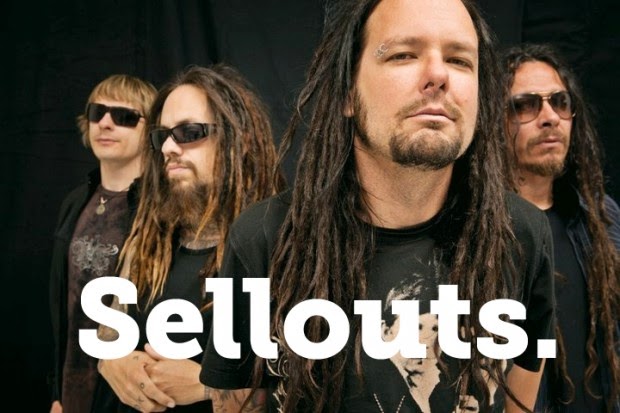
I don't remember how, exactly, I found it, but I remember holding the CD in my hand and looking at this picture and thinking "what the fuck?":


I found that image deeply disturbing... which, of course, meant I had to buy it.  It wasn't until I got home that I looked at the song titles and saw that the sixth track was called "Faget." My heart sank. Because I was a faggot. Not literally, but it was a word that had been thrown at me many, many times, and to this day it churns my guts more than almost any other. Immediately I felt a hostile relationship with this band that I knew nothing about.

I opened the jewel case, expecting to see a band photo. There was one, but you couldn't really make out what anyone looked like. Jonathan Davis's face was obscured by a black hoodie. You caught a hint of a scowl, but that was it. I hadn't even put the CD into my player yet, and I already felt a sense of real menace. For a horror fan like me, menace is good. I was intrigued.

So I put the CD into my boombox (yeah, we still had those), braced myself and went immediately to track six.

This is what I heard:


It's hard to hear it now with the same ears I had in 1994... but I do remember that literally nothing sounded like it at the time. Technically, of course, that's not true. Coal Chamber – maybe the first band to be widely accused of ripping off Korn's sound — actually predated Korn by a few months, but they didn't manage to put out an album until three years later. And, of course, Deftones were doing their thing. But I wouldn't really become aware of them for another year or two.

Korn was something utterly new to me.

The first time I had a song or an album crack my brain open and pour something new into it was when I heard Creedence Clearwater Revival's "Sinister Purpose" when I was seven and on a cross-country road trip with my parents. Even way back then I was kind of a dark kid with a weird imagination, and "Sinister Purpose" hit a sweet spot I didn't even know was there.

The second time was when my brother gave me a cassette tape of Pink Floyd's "The Wall" when I was maybe eleven or twelve and I heard "One of My Turns," followed immediately by "Don't Leave Me Now." Whatever inner blackness John Fogerty had hinted at with "Sinister Purpose" was just right there in its full, lunatic glory in Roger Waters's demented magnum opus. Even now when people refer to Floyd as "space rock" I can't help but snicker. Unless you're talking about the space between existential dread and a full-on psychotic break, the term just doesn't apply.

The third time was when I heard "Faget."

Make no mistake about it, I was an angry kid. I had a few legitimate reasons to be angry, and a lot of bullshit teenage ones too. But I was also a shy kid, so I rarely if ever expressed that anger in any outward way. I'd occasionally melt down (usually in front of my parents), but more often I would just turn it inward and pick at it and pick at it until it felt raw and bloody. I was angry at myself, angry at the world, and didn't know who to lash out at. I've never related to the Columbine shooters, but I'm self aware enough to know I at least had a seed of that in me at that time. I don't know what it would have taken to push me there, but I suspect it would have been less than I would now like to believe.

Frankly, it was discovering writing and horror — and realizing that I had talent — that got me through it.

Korn expressed that particular sense of rage in a way that was ugly, painful and very specific. As soon as I realized Davis was calling himself a faggot, I locked in. This was me. In simplistic terms, you could call the song an anti-bullying anthem, but that reduces it to its most basic elements. It was a scream from the reptile brain, and one I deeply recognized. At the time, I felt like Davis wasn't so much singing as he was channeling the black stew of my own emotions into audio form and then throwing them back at me.

So that's what Korn meant to 16-year-old Scotty. They mean something very different to me now. They hit big a couple years later with "Life Is Peachy" and then went into the stratosphere with "Follow the Leader." Good for them. I'm not one of those guys to immediately abandon a favorite band as soon as they get popular.

But it took almost no time for them to turn into a parody of the very thing they had seemed to be railing against.

I mean, how do go from that to this?


I'm sure they justify the use of the word "faggot" in this song by saying that it's meant to be ironic and that they're subverting the overt machismo or whatever (and, to be fair, the final refrain gives that idea at least a little bit of weight). But that's a cop-out. Fundamentally, this song is an excuse for dumb guys to say "faggot" to each other. It's not even the use of the word that offends me, but the posturing. And the simple fact that Davis is revealing his true pathetic self here: after all his outsider raging, it turns out he really did just want to be one of the cool kids after all.

Korn simply cannot be forgiven for introducing the world to Fred Durst and Limp Bizkit. Their legacy, such as it is, will be forever tainted. This is true even if they hadn't started making absolute shit music in the late 90s and the aughts.

I'd be lying if I said there wasn't a minute there where I liked Limp Bizkit. That first album felt sort of fresh, I guess, for about six months. And, for the record, I also liked Sugar Ray for awhile. "Streaker" is still one of my favorite songs. I was already pretty open to the whole rap-metal thing because of Rage Against the Machine, Downset, Stuck Mojo, and Anthrax's much earlier collaboration with Public Enemy.

But from almost the very second I heard "Nookie," I was done. Durst represented everything to me that Korn (and Marilyn Manson and NIN) had been an escape from. And he brought garbage like Crazy Town and Staind and (gag) Papa Roach along in his wake.

Korn, frankly, must be held accountable for this. They had helped create something that I still believe could have been uniquely raw and vital for an entire generation of misfit kids, and then they turned their backs and kicked the door open and let all the dudebros in after them. It was a musical and cultural betrayal of epic proportions.

As part of writing "The Darks," I created a "Devin Fucking Mackie's Badass 90s Playlist" on Spotify, and — for fun — I culled through a bunch of that late 90s post-Korn nü metal that I listened to for awhile. And I was surprised to find that, for all the trash, there's still plenty there I like. Disturbed's "Stupify," for instance. Or Chevelle's "Point #1." Is this great music? Not really. Is it dated? For sure. But it meant something to me at the time, and I'm not ashamed to say it still does, at least a little bit.

And I will always contend that that first Korn album truly was something special. But I guess you kind of had to be there. Their later sins in regards to the douche-ification of the late 90s are singular and specific, but for better or worse they are probably the most influential rock band that came in the immediate aftermath of Nirvana. Like all influential bands, they spawned a ton of really terrible imitators. But they opened the door for a few good ones, too. And their influence extended way beyond what we traditionally think of as "nü metal." You can hear it in the guitar and base sound on Sepultura's "Roots," which I think may be the single best metal album of that entire decade. You also hear it on Fear Factory's "Obsolete.". And then Slipknot came along,  took what they were doing and cranked it all full of meth in the most beautiful way.

Let's not even talk about Emo.

As I said, nostalgia can be dangerous. I'm glad that, in the end, this is a phase I mostly grew out of. The years after college would bring me into contact with music much more emotionally sophisticated and (indeed) more frightening than anything these guys could conceive of. Nick Cave and the Bad seeds ended up being the fourth (and so far last) time I had my skull cracked open by a band. They were a game changer for me. I don't care how raw you scream, how loud and downtuned your guitars are or what fucked-up costumes you wear on stage, you'll never be able to craft anything as sublimely disturbing as this:


Or this:


Or, frankly, this:


I'll never really be able to call myself a Korn fan again. But, as I take it upon myself to reconnect to my past, it's sort of nice to discover that I can still find something of value there.